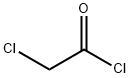
General Description
A colorless to light yellow liquid with a very pungent odor. Very toxic by inhalation. Corrosive to metals and tissue.
Reactivity Profile
CHLOROACETYL CHLORIDE reacts rapidly with water. Incompatible with strong oxidizing agents, alcohols, bases (including amines). May react vigorously or explosively if mixed with diisopropyl ether or other ethers in the presence of trace amounts of metal salts [J. Haz. Mat., 1981, 4, 291].
Hazard
Irritant to eyes, corrosive to skin. Upper
respiratory tract irritant.
Health Hazard
Inhalation causes severe irritation of upper respiratory system. External contact causes severe irritation of eyes and skin. Ingestion causes severe irritation of mouth and stomach.
Potential Exposure
Highly toxic by inhalation.
Chloroacetyl chloride is used in the manufacture of acetophenone. It is used in the manufacture of a number of pesticides including: alachlor, allidochlor, butachlor,
dimethachlor, formothion, mecarbam, metolachlor, propachlor. It is also used in the manufacture of pharmaceuticals,
such as chlordiazepoxide hydrochloride, diazepam, lidocaine, mianserin.
First aid
If this chemical gets into the eyes, remove any
contact lenses at once and irrigate immediately for at least
15 minutes, occasionally lifting upper and lower lids. Seek
medical attention immediately. If this chemical contacts the
skin, remove contaminated clothing and wash immediately
with soap and water. Seek medical attention immediately.
If this chemical has been inhaled, remove from exposure,
begin rescue breathing (using universal precautions, including resuscitation mask) if breathing has stopped and CPR if
heart action has stopped. Transfer promptly to a medical
facility. When this chemical has been swallowed, get medical attention. If victim is conscious, administer water or
milk. Do not induce vomiting. Medical observation is
recommended for 24 to 48 hours after breathing overexposure, as pulmonary edema may be delayed. As first aid for
pulmonary edema, a doctor or authorized paramedic may
consider administering a drug or other inhalation therapy.
Shipping
UN1752 Chloroacetyl chloride, Hazard class:
6.1; Labels: 6.1-Poison Inhalation Hazard, 8-Corrosive
material, Inhalation Hazard Zone B.
Incompatibilities
Reacts violently with water, steamforming chloroacetic acid and hydrogen chloride gas.
Reacts with alcohols, powdered metals; sodium amide;
combustibles; and many organics, causing toxic fumes, fire,
and explosion hazard. On contact with air it emits corrosive
gas. Decomposes when heated forming phosgene gas.
Corrosive to metals.
Description
Chloroacetyl chloride is a colorless to yellowish liquid with a very pungent, extremely irritating, odor.Molecular weight=112.95; Specific gravity (H2O:1) 51.42; Boiling point=105℃; Freezing/Meltingpoint=222℃; Vapor pressure=19 mmHg at 20℃.NFPA 704 M Rating System: Health 3, Flammability 1,Reactivity 1 . Reacts violently with water.
Chemical Properties
Chloroacetyl chloride is a colorless to yellowish
liquid with a very pungent, extremely irritating, odor.
Chemical Properties
Clear colorless liquid
Waste Disposal
It may be discharged into
sodium bicarbonate solution, then flushed to the sewer with
water.
Uses
In the synthesis of organic compounds.
Uses
Intermediate in manufacture of
chloroacetophenone and various other
chemicals
Application
Chloroacetyl chloride can be used for chloroacetylation and chemical modification of poly(glycidyl methacrylate).
Chloroacetyl chloride was used to study the in vitro metabolism of chloroacetamide herbicides by rat and human liver microsomes. Chloroacetyl chloride was used in the synthesis of some novel quinoline derivatives having antileishmanial activity.
Preparation
Chloroacetyl chloride is usually manufactured from chloroacetic acid by reaction with phosphorus trichloride, thionyl chloride, sulfuryl chloride, or phosgene. It is also obtained by chlorination of acetyl chloride in the presence of stronger aliphatic acids, preferably chloroacetic acids, or from sodium chloroacetate and the usual chlorinating agents.
Koenig G et al; Chloroacetic Acids. Ullmann's Encyclopedia of Industrial Chemistry 7th ed. (1999-2018). NY, NY: John Wiley & Sons. Online Posting Date: October 15, 2012
Carcinogenicity
Chloroacetyl chloride was not genotoxic in
a number of assays.
storage
Chloroacetyl chloride must carry a“CORROSIVE” label. It falls in Hazard Class 8 andPacking Group I.