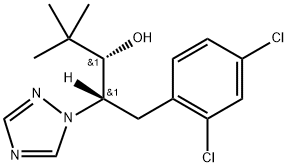
Description
Dichloburazol is a discontinued fungicide. It has a low aqueous solubility and is volatile. There are significant gaps in reported fate data. Dichlobutrazol has a low mammalian toxicity but is moderately toxic to fish. It is relatively non-toxic to honeybees.
Chemical Properties
Diclobutrazol is a white crystal. Soluble in acetone, chlorine, methanol, ethanol and other organic solvents; slightly soluble in water, the solubility in water is 9mg/L. It is stable to acid, alkali, light and heat. Under the condition of strong acid and alkali, the hydrolysis half-life is 5d at 80℃. Under the condition of pH value of 4~9, its aqueous solution is stable to natural light for more than 33d. At 50℃, 37℃ Under the conditions, the stability of the original drug is above 90d and 182d, respectively.
Uses
Diclobutrazol, a systemic fungicide, is highly active against rusts, powdery mildews, and other fungal phytopathogens. Diclobutrazol can be used as a pesticide to control of various crop diseases, such as powdery mildew, smut of wheat, sheath blight of rice, etc.
Definition
ChEBI: Diclobutrazol is a conazole fungicide and a triazole fungicide.
Production Methods
Diclobutrazol is commercially synthesised by condensing 2,4-dichlorobenzyl chloride with a triazole-based alcohol. The production process begins with the preparation of 2,4-dichlorobenzyl chloride, which is reacted with 1H-1,2,4-triazole-1-ethanol under basic conditions to form the key intermediate. This step involves nucleophilic substitution, where the hydroxyl group of the triazole alcohol displaces the chloride atom.
Mechanism of action
Systemic, absorbed through leaves, stem and roots and translocated. Known to block fungal sterol biosynthesis.