Description
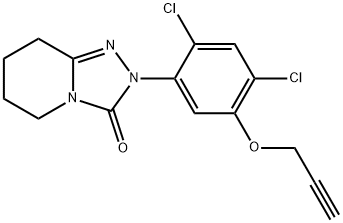
Azafenidin is a triazolinone herbicide used to control broadleaved weeds and grasses. It has a moderate aqueous solubility, is semi-volatile and moderately persistent in soil. It does not persist in water in daylight conditions. Whilst the pesticide is not highly toxic to mammals there is a risk of bioaccumulation. Azafenidin shows a low to moderate toxicity to birds, most aquatic organisms and honeybees.
Chemical Properties
The pure product is a rust-colored solid with a strong odor. Its mp is 168-168.5°C, relative density is 1.4 (20°C), vapor pressure is 1×10⁻⁹ Pa (25°C), and solubility in water is 12 mg/L (pH=7). Its partition coefficient is 2.7, and it is stable to hydrolysis. Its half-life in water under light exposure is approximately 12 days.
Uses
Azafenidin is a weed controlling herbicide used in various crops.
Definition
ChEBI: Azafenidin is a triazolopyridine that is 5,6,7,8-tetrahydro[1,2,4]triazolo[4,3-a]pyridin-3(2H)-one which is substituted at position 2 by a 2,4-dichloro-5-(prop-2-yn-1-yloxy)phenyl group. A protoporphyrinogen oxidase inhibitor, it is used as a herbicide to control weeds in fruit crops such as pineapple, citrus, melons, and grapes. Not approved for use within the European Union. It has a role as an EC 1.3.3.4 (protoporphyrinogen oxidase) inhibitor. It is a triazolopyridine, a terminal acetylenic compound and a dichlorobenzene.
Production Methods
There is limited publicly available detail on the specific industrial synthesis of azafenadin. However, generally it is produced through a multi-step chemical synthesis involving aromatic and heterocyclic intermediates, followed by purification processes such as crystallisation or distillation.
Mechanism of action
Inhibition of protoporphyrinogen oxidase, selective with some residual effect
Metabolic pathway
A common degradation reaction of azafenidin in light,
plants and soil is O-dealkylation, and interesting minor
reactions in soil are the subsequent methylation of the
O-dealkylated degradation product and the reduction
of the propynyl group under anaerobic conditions. In
soil and light, azafenidin is also readily split to form
the triazolinone heterocycle. Azafenidin is readily
metabolized in rats and lactating goats through
O-dealkylation, hydroxylation of the triazolinone ring
in several positions, and glucuronide and sulfate
conjugation.