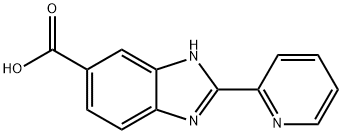
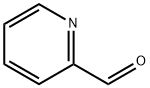
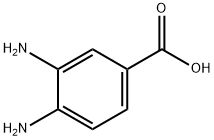
To a suspension of 3,4-diaminobenzoic acid (0.6 g, 3.94 mmol, 1 eq.) in ethanol (6 mL) was added a solution of copper acetate monohydrate (0.86 g, 4.33 mmol, 1.1 eq.) in water (10 mL) and pyridine-2-carboxaldehyde (0.42 mL, 4.33 mmol, 1.1 eq.) in that order. The reaction mixture was stirred at 100 °C for 2 hours. Upon completion of the reaction, the black precipitate was collected by filtration and dispersed in ethanol (4 mL). Subsequently, sodium polysulfide (Na2Sx-H2O, 1.7 g) was added and the mixture was stirred at 100 °C for 30 min. The resulting solid was filtered from the hot solution and the filter cake was washed with hot water. The filtrate was adjusted to pH 2 with hydrochloric acid (HOI) and subsequently heated at 80 °C to remove hydrogen sulfide (H2S). After cooling, the mixture was filtered, the filtrate concentrated and recrystallized from ethanol. The resulting dihydrochloride product was mixed with an equal amount of ethanol solution of potassium hydroxide (KOH). The solid was removed by filtration and the filtrate was concentrated to give the final target product 2-(pyridin-2-yl)-1H-benzo[d]imidazole-6-carboxylic acid (0.447 g, 47% yield) as a brown solid.