Synthesis
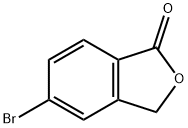
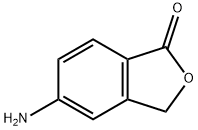
The general procedure for the synthesis of 5-bromophthalide from 5-aminophthalide was as follows: first, 5-nitrophthalimide (8) was prepared by nitration of phthalimide (7), using 200 g of phthalimide (7) in a mixture of HNO3 and H2SO4 acids at 0 °C to give 146 g of the product (8) in 56% yield. Subsequently, 8 was reduced to amine 9 by catalytic hydrogenation, using 5% Pd/C as catalyst, in EtOAc solvent in 97% yield. This step encountered the bottleneck of high solvent usage in large-scale operation. The improved method used the catalytic reduction reaction of zinc powder and copper(II) sulfate in 6 M NaOH aqueous solution to prepare aminophthalide 10 directly from 8 in one step in 100% yield, which effectively solved the bottleneck problem. Aminophthalide 10 was converted to 5-bromophthalide 11 in 76% yield by the Sandmeyer reaction in the presence of NaNO2 and 4 M HBr at 0 °C, followed by the addition of CuBr. A single batch yielded 36 g of 11. Next, 11 was reduced by diisobutylaluminum hydride (DIBAL) in toluene at -42 °C to give bromolactone 12 in 77% yield . Finally, 12 was reacted with boron trifluoride ether compounds in methanol to prepare bromoacetal 6 in 96% yield. The whole synthetic route was efficient and only the last two steps (e and f) required purification of the product by chromatography.
References
[1] Patent: US2011/77394, 2011, A1. Location in patent: Page/Page column 15
[2] Patent: CN108383833, 2018, A. Location in patent: Paragraph 0013
[3] Journal of the Chemical Society, 1931, p. 867,869
[4] Journal of Heterocyclic Chemistry, 2006, vol. 43, # 5, p. 1195 - 1204
[5] European Journal of Medicinal Chemistry, 2010, vol. 45, # 5, p. 1941 - 1946