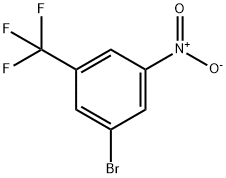
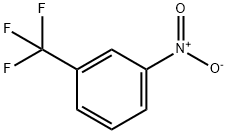
Example 14 Synthesis of 1-bromo-3-nitro-5-trifluoromethylbenzene (XI): To a solution of 1-nitro-3-trifluoromethylbenzene (41.1 mL, 300 mmol, 97%, purchased from Aldrich) in dichloromethane (240 mL) was slowly added 98% sulfuric acid (45.7 mL, 840 mmol) over a 10 minute period. The two-phase mixture obtained with vigorous stirring was heated to 35 °C and 1,3-dibromo-5,5-dimethylimidazolidine-2,4-dione (total 53.1 g, 180 mmol) was added in six equal portions over 5 hours. The mixture was continued to be stirred at 35 °C for 19 h. HPLC analysis showed more than 97% conversion of the starting material. After the reaction mixture was cooled to room temperature, it was added dropwise to a stirred aqueous 2 M NaOH solution (210 mL) at 0-5 °C over 20 min, during which time it was cooled in an ice-water bath, and the internal temperature was briefly raised to about 35 °C. The reaction mixture was then cooled to room temperature, and the internal temperature was raised to about 35 °C. The reaction mixture was then cooled to room temperature. The two layers were separated and the aqueous layer was extracted with hexane (3 x 200 mL). The combined organic layers were washed sequentially with water (200 mL), 5% aqueous sodium bisulfite (2 x 200 mL), 8% aqueous NaHCO3 (200 mL), and 10% aqueous NaCl (200 mL), followed by evaporation of the solvent at 45 °C under reduced pressure. The resulting liquid was distilled at 0.71 mbar and a bath temperature of 70-80 °C to give 1-bromo-3-nitro-5-trifluoromethylbenzene as a light yellow liquid in 89.6% yield (1H-NMR purity about 95%).1H-NMR (400 MHz, CDCl3): δ 8.11 (m, 1H), 8.45 (m, 1H), 8.58-8.59 (m, 1H). 1H). Boiling point: ca. 68 °C (0.71 mbar).