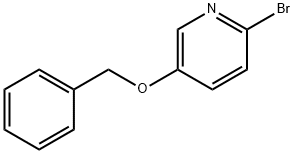
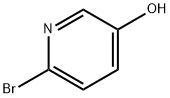
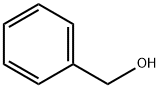
To a 1 L round bottom flask equipped with a large stirrer was added 6-bromopyridin-3-ol (24.69 g, 142 mmol), benzyl alcohol (15.42 mL, 149 mmol), triphenylphosphine (39.1 g, 149 mmol) and tetrahydrofuran (600 mL). The flask was placed in a room temperature water bath. Diisopropyl azodicarboxylate (DIAD, 29.0 mL, 149 mmol) was added to the stirred solution in six batches. The internal temperature was increased from 20 °C to 35 °C during the reaction and maintained at 35 °C after the addition was completed. After stirring the reaction for 18 hours, the reaction solution was concentrated under reduced pressure to give a liquid residue. This residue was diluted with a solvent mixture of hexane and ether (1:1, 850 mL), and precipitate generation was immediately observed. The mixture was stirred for 5 minutes and then decanted and the supernatant retained. The solid fraction was treated with ether (200 mL) and stirred again for 5 minutes. Subsequently, hexane (200 mL) was added to the solution and stirring was continued for 5 minutes. The above treated mixture was combined with the previously retained supernatant and vacuum filtered through a fine pore sintered glass funnel. The filtrate was concentrated under reduced pressure and the resulting residue was dissolved in a small amount of acetone and concentrated again under reduced pressure onto diatomaceous earth. The resulting powder was separated by silica gel column chromatography (using a 330 g silica gel column with a gradient ratio of hexane/ethyl acetate, 100:0 to 80:20, as eluent), resulting in 5-(benzyloxy)-2-bromopyridine as a colorless crystalline solid (24.84 g, 66% yield). The product was characterized by 1H NMR (400 MHz, chloroform-d): δ 8.16 (d, J = 3.2 Hz, 1H), 7.45-7.36 (m, 6H), 7.18 (dd, J = 8.6,3.2 Hz, 1H), 5.12 (s, 2H).