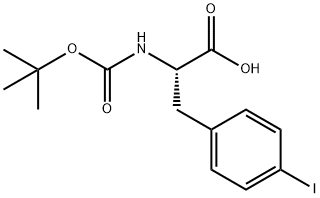
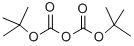
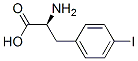
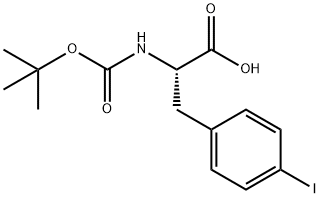
The reaction was carried out as follows: a 3L three-neck flask was used. (S)-4-Iodo-L-phenylalanine (200.00 g, 687.10 mmol, 1.00 eq.), 1,4-dioxane (1.00 L) and water (1.00 L) were added sequentially to the reaction flask, followed by the addition of sodium hydroxide (68.71 g, 1.72 mol, 2.50 eq.), which led to a gradual clarification of the solution and a slight increase in temperature to 19 °C. The reaction was carried out using a three-necked flask. After the system was cooled to 0-10 °C, di-tert-butyl dicarbonate (254.93 g, 1.17 mol, 268.35 mL, 1.70 eq.) was added slowly dropwise and the reaction temperature was naturally increased to 10-30 °C. The reaction was then carried out at room temperature with the addition of sodium hydroxide (68.71 g, 1.72 mol, 2.50 eq.). After addition, the reaction system was stirred at room temperature (about 30 °C) for 8 hours. The reaction process was monitored by high performance liquid chromatography (HPLC) until the feedstock was fully converted. Subsequently, the temperature of the system was controlled to be below 40 °C and concentrated under reduced pressure to remove 1,4-dioxane. After the reaction mixture was cooled to room temperature (about 25 °C), the reaction was quenched by the addition of 100 mL of water and the pH was adjusted to 1.8-2.0 with 2 M hydrochloric acid. the resulting mixture was extracted three times with ethyl acetate (2 L x 3). The organic phases were combined, washed twice sequentially with saturated brine (1L×2), dried with anhydrous sodium sulfate (200 g), and concentrated under reduced pressure to give a light yellow solid crude product. The crude product was dried in an oven at 40-45 °C to obtain white solid (S)-N-Boc-4-iodo-L-phenylalanine (250.00 g, 626.28 mmol, 93.00% yield, 98% HPLC purity). The structure of the product was confirmed by 1H NMR (400 MHz, DMSO-d6): δ 7.49 (d, J = 7.8 Hz, 2H), 6.88 (d, J = 7.8 Hz, 2H), 5.80 (d, J = 5.9 Hz, 1H), 3.68 (d, J = 5.5 Hz, 1H), 3.00-2.90 (m, 1H), 2.87- 2.75 (m, 1H), 1.35-1.15 (m, 9H).