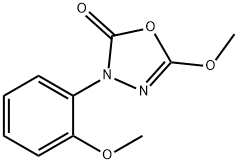
Chemical Properties
The pure product is pale yellow to reddish-brown crystals or crystalline powder. MP 79.5°C, vapor pressure 0.147 Pa (25°C), relative density 1.401-1.410, flash point 160°C, ignition temperature 390°C. It is readily soluble in acetone, chloroform, ethyl acetate, chloromethane, and anisole; moderately soluble in methanol, xylene, and trichloroethane; soluble in ethanol, isopropyl alcohol, trimethylbenzene, and alkylbenzenes; and practically insoluble in water, cyclohexane, and kerosene. It is stable at room temperature but unstable above 50°C. A highly stable agent can be obtained by adding Sumillizer-TNP (2%). Its explosiveness is within the lower explosion limit of dust. At 40°C, the residual rates after six months in the following solvents were: acetone 97.7%, methanol 85.3%, isopropyl alcohol 95%, ethyl acetate 99.8%, cyclohexanone 100.5%, xylene 101.0%, chloroform 93.2%, and trichloroethane 102.0%. This indicates that the agent readily decomposes in methanol but is stable in other solvents. While the agent is unstable in bentonite and sodium carbonate (at 40°C, the residual rates for the six solvents were 85.7% and 16.0%, respectively), it is stable in all other carriers. Xenon lamp irradiation tests have shown that the agent gradually decomposes under light. Furthermore, humidity also affects the agent's effects.
Production Methods
The commercial production process of metoxadiazone is not described in open literature. However, the generic process for oxadiazolone insecticides is that they are typically produced by assembling the oxadiazolinone ring from appropriate hydrazide and carbonyl precursors, followed by aryl substitution to introduce the 2 methoxyphenyl group and O methylation to yield the methoxy substituted heterocycle.
Mechanism of action
Selective, induces stunting and chlorosis. It works by blocking adrenergic receptors, leading to the relaxation of vascular smooth muscles and inhibition of norepinephrine secretion from the adrenal glands