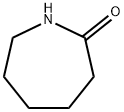
Example 1: To a 1 liter reactor were sequentially added 34 g (0.3 mol) of caprolactam, 112 g (0.45 mol) of dodecyl bromide, 300 g of toluene, 3.4 g (3.3 mol %, based on caprolactam) of crystalline tetrabutylammonium hydrogensulphate (TBAHS), and 90 g (2.25 mol) of flaked sodium hydroxide. The resulting non-homogeneous mixture was stirred and reacted at 50°C for 10 hours. Upon completion of the reaction, the mixture was cooled to 40 °C, followed by addition of 135 g of water and continued stirring at the same temperature for 30 min. After the reaction solution was layered, the oil layer was separated and purified by distillation, and the fractions with boiling points ranging from 195°C to 200°C/3mmHg were collected to give 84.0 g of 1-dodecyl azepan-2-one (99.6% yield, based on caprolactam), with a by-production of 0.8 g of dodecyl ether (1.0% yield, based on bromododecane).