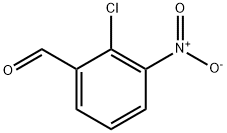
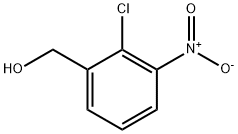
Step 2. Synthesis of 2-chloro-3-nitrobenzaldehyde: To a 250 mL three-necked round-bottomed flask, a solution of oxalyl chloride (5.42 g, 42.70 mmol, 1.10 eq.) in dichloromethane (DCM, 100 mL) was added. Subsequently, a solution of dimethyl sulfoxide (DMSO, 6.65 g, 85.11 mmol, 2.20 eq.) in DCM (15 mL) was added dropwise and the reaction system was kept at -78 °C. At this temperature, a solution of (2-chloro-3-nitrophenyl)methanol (7.23 g, 38.54 mmol, 1.00 eq.) in DCM (35 mL) was slowly added and stirred continuously for 1 hour. Then, triethylamine (TEA, 30 mL) was added at the same temperature and stirring was continued for 1 hour. Upon completion of the reaction, the reaction was quenched with water and extracted with DCM (3 x 100 mL). The organic layers were combined, dried over anhydrous sodium sulfate, filtered and concentrated on a rotary evaporator. The residue was purified by silica gel column chromatography using petroleum ether (PE):ethyl acetate (EA) = 10:1 as eluent to afford 2-chloro-3-nitrobenzaldehyde (5.3 g, 74% yield) as a light yellow solid.