Hazard
Due to its ability to catalyze calcium deposition in the bony structure (thus preventing rickets),
overdosage of vitamin D may be harmful.
Description
Ergosterol is a membrane component and with few
exceptions is restricted to eumycotic fungi (101). As a
constituent of intact membranes, its abundance should
reflect the amount of living fungal biomass in an
environment. This membrane component has been related
to biomass by a number of investigators and the values
range from 1.9 to 11.5 mg ergosterol g?1 mycelium (102).
These conversion factors yield very high values for fungal
biomass, and seem unrealistic (102) when compared with
independent measures of bacterial biomass. It is likely
that the ergosterol assay detects nonliving hyphae and
these measures may overestimate viable fungal biomass.
Similarly, chitin is a dominant cell wall component in
most fungi and has been proposed as a unique marker
for total fungal biomass.
Chemical Properties
solid
Definition
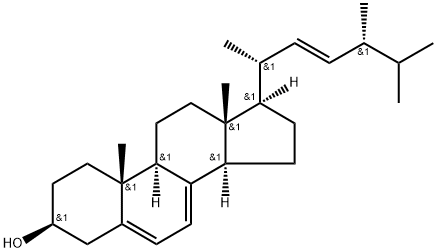
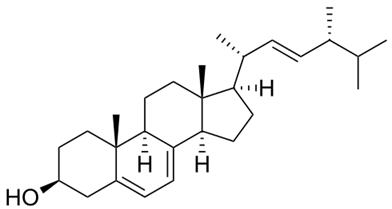
ChEBI: A phytosterol consisting of ergostane having double bonds at the 5,6-, 7,8- and 22,23-positions as well as a 3beta-hydroxy group.
Definition
ergosterol: A sterol occurring infungi, bacteria, algae, and plants. It isconverted into vitamin D2 by the actionof ultraviolet light.
General Description
Ergosterol or provitamin D2 is a biological precursor of Vitamin D2. It is found predominantly in cell membranes of fungi and protists such as trypanosomes.
Biochem/physiol Actions
Ergosterol has a role in maintaining the integrity of the cell membrane and its fluidity. The sterol has anti-tumor and anti-inflammatory properties.
Synthesis
Ergosterol is an important component of fungal cell membranes and is primarily obtained through industrial fermentation. Yeast strains, such as Saccharomyces cerevisiae, can naturally synthesize this compound via the mevalonate pathway. This biosynthetic pathway involves farnesyl pyrophosphatase-catalyzed conversion to squalene, followed by squalene cyclization to lanosterol, and then a series of subsequent demethylation, oxidation, and desaturation steps to finally produce ergosterol. While total chemical synthesis is useful for research, large-scale production relies on optimizing fermentation conditions and using synthetic biology techniques to modify yeast metabolic pathways to increase yield.
Purification Methods
Crystallise ergosterol from EtOAc, then from ethylene dichloride or EtOH/*C6H6 (3:1). It has been purified by conversion to the isobutyl ester which crystallises from Et2O/Me2CO (1:3) with m: turbid at 148o, melts at 159o and becomes clear at 162o, followed by hydrolysis, [Bill & Honeywell J Biol Chem 80 15 1938]. When crystallised from EtOH, it forms the 1.5-hydrate m 168o. The water is difficult to remove giving an amorphous solid m 166-183o, b 250o/high vacuum. It is light sensitive. The benzoate has m 169-171o, after crystallisation from Me2CO/*C6H6 (4:1) after prolonged standing at 0o and becomes highly charged, with [�] D20 -177o (c 1, CHCl3). [UV of sterols: Hogness et al. J Biol Chem 120 239 1937, Beilstein 6 IV 4407.]