Chemical Properties
green crystalline powder
Definition
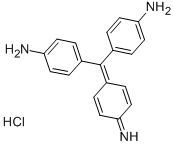
ChEBI: A hydrochloride that is the monohydrochloride of 4,4'-[(4-iminocyclohexa-2,5-dien-1-ylidene)methanediyl]dianiline. One of the major constituents of Basic fuchsin, together with rosanilin, magenta II and new fuchsin.
General Description
Colorless to red crystals or green powder.
Air & Water Reactions
Insoluble in water.
Health Hazard
ACUTE/CHRONIC HAZARDS: When heated to decomposition Basic Red 9 emits very toxic fumes of hydrogen chloride and nitrogen oxides.
Fire Hazard
Flash point data for Basic Red 9 are not available; however, Basic Red 9 is probably combustible.
Potential Exposure
Used as a dye for textiles, paper;
printing, computer and photo imaging inks, leather, and
many consumer products; as a microbiological/microscopy
stain for bacilli, including tubercle and influenza.
First aid
Eyes: first check the victim for contact lenses
and remove if present. Flush victim’s eyes with water or
normal saline solution for 20 to 30 minutes while simultaneously
calling a hospital or poison control center. Do not
put any ointments, oils, or medication in the victim’s eyes
without specific instructions from a physician. Immediately
transport the victim after flushing eyes to a hospital even if
no symptoms (such as redness or irritation) develop. Skin:
immediately flood affected skin with water while removing
and isolating all contaminated clothing. Gently wash all
affected skin areas thoroughly with soap and water. If
symptoms such as redness or irritation develop, immediately
call a physician and be prepared to transport the victim
to a hospital for treatment. Inhalation: immediately
leave the contaminated area; take deep breaths of fresh air.
Immediately call a physician and be prepared to transport
the victim to a hospital even if no symptoms (such as
wheezing, coughing, shortness of breath, or burning in the
mouth, throat, or chest) develop. Provide proper respiratory
protection to rescuers entering an unknown atmosphere.
Whenever possible, SCBA should be used; if not available,
use a level of protection greater than or equal to that
advised under protective clothing. Ingestion: do not induce
vomiting. If the victim is conscious and not convulsing,
give 1 or 2 glasses of water to dilute the chemical and
immediately call a hospital or poison control center. Be
prepared to transport the victim to a hospital if advised by
a physician. If the victim is convulsing or unconscious, do
not give anything by mouth, ensure that the victim’s airway
is open and lay the victim on his/her side with the head
lower than the body. Do not induce vomiting. Immediately
transport the victim to a hospital. Other: since this chemical
is a known or suspected carcinogen you should contact
a physician for advice regarding the possible long-term
health effects and potential recommendation for medical
monitoring. Recommendations from the physician will
depend upon the specific compound, its chemical, physical
and toxicity properties, the exposure level, length of exposure,
and the route of exposure.
Shipping
UN 3143 Dyes, solid, toxic, n.o.s., or dye intermediates,
solid, toxic, n.o.s., Hazard Class: 6.1; Labels:
6.1—Poisonous materials, Technical Name Required.
Incompatibilities
May be combustible; powder or liquid
may form explosive mixture with air. Incompatible with
oxidizers (chlorates, nitrates, peroxides, permanganates,
perchlorates, chlorine, bromine, fluorine, etc.); contact may
cause fires or explosions. Keep away from alkaline materials,
strong bases, strong acids, oxoacids, epoxides.
Waste Disposal
Use a licensed professional
waste disposal service to dispose of this material. Dissolve
or mix the material with a combustible solvent and burn in
a chemical incinerator equipped with an afterburner and
scrubber. All federal, state, and local environmental regulations
must be observed.
Preparation
commonly known as (Para Magenta, Para Rosaniline) (a) 4-(4-Aminobenzyl)benzenamine?and aniline, Aniline hydrochloride, the difficulties and ferric chloride in 170 ℃ heating hours;?(b) aniline,p-Methylaniline and its hydrochloride and iron, ferrous chloride or 1-Nitrobenzene?heating; (C) aniline?and p-Methylaniline?was treated with arsenic oxide; (d) aniline?tetrachloride carbon heat.
Biological Activity
Basic fuchsin possesses anestheticbactericidal (gram-positive)and fungicidal properties.
Synthesis
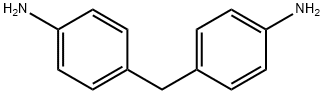
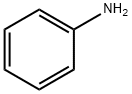
Basic magenta was prepared by synthesizing 4,4'-((4-iminocyclohexane-2,5-diene-1-idene)methylene)diphenylamine hydrochloride by air oxidation reaction in the presence of a cesium vanadate catalyst using 4,4'-diaminodiphenylmethane and aniline as raw materials in the following steps: (1) in a four-necked flask, a mixture of 4,4'-diaminodiphenylmethane and aniline was added at a weight ratio of 20:1 to obtain Mixture A. Four ports of the four-necked flask were fitted with a condenser, a water separator, a thermometer and an air introduction tube, and the flask was equipped with a stirrer. aniline in a four-necked flask at a weight ratio of 20:1 to obtain mixture A. The four ports of the four-necked flask were respectively fitted with a condenser, a water separator, a thermometer, and an air introduction tube, and the flask was equipped with a stirrer; (2) under stirring conditions, a 30% HCl solution weighing 0.77 times the weight of 4,4'-diaminodiphenylmethane was added to mixture A until it was completely dissolved, obtaining solution B; (3) solution B was added to solution B weighing 1% to 4% by weight of 4,4'-diaminodiphenylmethane as cesium vanadate catalyst to solution B to obtain solution C; (4) heating solution C to 140° C. and continuously passing air at this temperature for 5 hours until no water is generated, and product D is obtained at the end of the reaction; and (5) azeotropic distillation of the product D, removing and recovering excess aniline to obtain crude oil. The crude oil was poured out of a four-neck flask and cooled to become brittle; (6) the brittle crude oil was ground and stirred with a dilute hydrochloric acid solution to pH ≤ 1 to obtain solution E; (7) solution E was stirred continuously for 6.5 hr, and then filtered through diatomaceous earth to obtain filtrate F; (8) the pH of the filtrate F was adjusted to 5 with a 0.4 mol/L NaOH solution at 24 °C, and filtered to obtain the filter cake G; ( (9) The filter cake G was dissolved in boiling water at pH=4, cooled to room temperature and left to crystallize for 16 hours, and finally filtered to obtain the solid product basic magenta crystals in 70% yield.
Carcinogenicity
Basic red 9 monohydrochloride is reasonably anticipated to be a human carcinogen based on sufficient evidence of carcinogenicity fromstudies in experimental animals.
Properties and Applications
colourful red blue light. Slightly soluble in cold water, soluble in hot water for red, easily soluble in ethanol is cherry red. The strong sulfuric acid for yellow brown, after dilute for purple. Used in the manufacture of blue ink, also can dye tannins mordant dyeing cotton.
|
Standard( Cotton )
|
Light Fastness
|
Persperation Fastness
|
Ironing Fastness
|
Soaping
|
|
Fading
|
Stain
|
Fading
|
Stain
|
Fading
|
Stain
|
|
A
|
2
|
1
|
|
|
|
1
|
|
Regulations
Department of Transportation (DOT)
Toxic dyes and toxic dye intermediates are considered hazardous materials, and special requirements have been set for marking, labeling, and transporting these materials.
References
[1] Patent: CN105936752, 2016, A. Location in patent: Paragraph 0323 - 0333