Synthesis
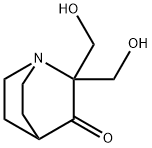
Example 1: Synthesis of 2,2-bis(hydroxymethyl)-1-azabicyclo[2.2.2]octan-3-one (2) (intermediate)
3-Quinuclidinone hydrochloride (1) (commercially available, 16.9 g, 0.1 mol) was reacted with formalin (37% w/w, 150 mL, 2.0 mol) in the presence of potassium carbonate (15.9 g, 0.11 mol) for 1 hr at 52°C until the feedstock was consumed. After completion of the reaction, the conversion was monitored by LC-MS. The aqueous reaction mixture was extracted with dichloromethane (4 x 80 mL), the organic phases were combined and dried with anhydrous magnesium sulfate. After evaporation of the solvent under reduced pressure, heptane (500 mL) was added to the residue and heated for 1 h. The hot heptane extract was expelled. Benzene (400 mL) was added to the residue and heating was continued for 8 hours. The reaction mixture was filtered from the polymer formed during heating to give a clarified solution which was subsequently evaporated to dryness. The residue was extracted with boiling heptane (300 mL) and after decanting the heptane, boiling benzene (400 mL) was added to the residue. After filtration and cooling to 6 °C, the solid precipitate was separated by filtration to give 5.1 g of 2,2-bis(hydroxymethyl)-1-azabicyclo[2.2.2]octan-3-one (2) (melting point: 136-138 °C). A second batch of product was isolated from the combined mother liquor and heptane extract to give 2.9 g of product. The total yield was 37%.
in vitro
the substantial increase in saos-2-his-273-cells death could be noticed after being treated with 125 μm prima-1 for 48 hours. tunel staining revealed that such tumor-cell death was primarily triggered by apoptosis. prima-1 could also restore the transcriptional transactivation function to mutant p53 in vitro. [2]
in vivo
to assess the effect of prima-1 on human tumor xenografts, mice were inoculated with saos-2-his-273 cells expressing mutant p53. the mice then received prima-1 treatment at intra-tumor does of 20 mg/kg or i.v. doses of 20 and 100 mg/kg twice a day for three days. compared with the control group, the average tumor volume decreased from 555.7 mm3 to 11.7 (100 mg/kg) and 53 (20 mg/kg) mm3 after i.v. injections of prima-1. intra-tumor injections of prima-1 also decreased the average tumor volume to 5.3 mm3. [2]
References
[1] bykov v, issaeva n, zache n, shilov a, hultcrantz m, bergman j, selivanova g, wiman kg. reactivation of mutant p53 and induction of apoptosis in human tumor cells by maleimide analogs. j biol chem. 2005 aug; 280(34): 30384–91.
[2] bykov v, issaeva n, shilov a, hultcrantz m, pugacheva e, chumakov p, bergman j, wiman kg, selivanova g. restoration of the tumor suppressor function to mutant p53 by a low-molecular-weight compound. nat med. 2002 mar; 8(3):282-8.
[3] lehmann s, bykov v, ali d, andren o, cherif h, tidefelt u, uggla b, yachnin j, juliusson g, moshfegh a, paul c, wiman kg, andersson po. targeting p53 in vivo: a first-in-human study with p53-targeting compound apr-246 in refractory hematologic malignancies and prostate cancer. j clin oncol. 2012. doi: 10.1200/jco.2011.40.7783.