Description
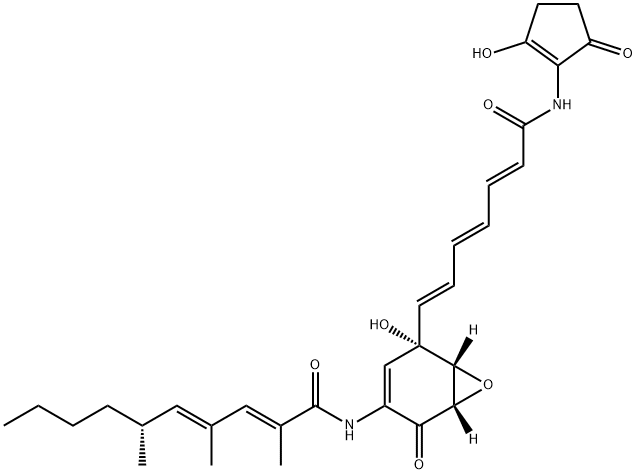
Manumycin A is an antibiotic that acts as a potent and selective farnesyltransferase (FTase) inhibitor with anti-tumor activity. It inhibits rat brain FTase with a Ki value of 1.2 μM, thereby preventing Ras activation which requires farnesylation at the C-terminus for membrane attachment. It exhibits significant antitumor activity against Ki-ras-activated solid tumors in mice at a dose of 6.3 mg/kg. Manymycin A inhibits IκB kinase (IKK), independent of FTase inhibition, in an number of cells types with effective concentrations of 2-10 μM. In ApoE-deficient mice, Manumycin A treatment for 22 weeks at 5 mg/kg reduced aortic fatty streak lesion size to 43% of vehicle-treated animals, indicating FTase inhibition as a potential target for prevention or treatment of atherosclerosis.
Uses
Manumycin A from Streptomyces parvulus has been used to inhibit IκB kinase (IKK)b?nuclear κ-B essential modulator (NEMO) interaction in the homogeneous time-resolved fluorescence (HTRF)-based binding assay.
Uses
Manumycin A is an antibiotic that acts as a potent and selective farnesyltransferase (FTase) inhibitor with anti-tumor activity.
Definition
ChEBI: Manumycin A is a polyketide with formula C31H38N2O7 initially isolated from Streptomyces parvulus as a result of a random screening program for farnesyl transferase (FTase) inhibitors. It is a natural product that exhibits anticancer and antibiotic properties. It has a role as an EC 1.8.1.9 (thioredoxin reductase) inhibitor, an EC 2.5.1.58 (protein farnesyltransferase) inhibitor, an antineoplastic agent, an apoptosis inducer, an antimicrobial agent, a bacterial metabolite, an antiatherosclerotic agent and a marine metabolite. It is a polyketide, an enamide, an epoxide, an organic heterobicyclic compound, a secondary carboxamide and a tertiary alcohol.
Biochem/physiol Actions
Manumycin A is a natural monomeric epoxyquinoid. It has an ability to inhibit tumor necrosis factor (TNF) induced IκB kinase (IKK) activity in various cell types. In addition, manumycin A exhibits anti-tumor property by inhibiting farnesylation of oncogenic Ras.
in vivo
Manumycin A (5 mg/kg; once every two days; 2 weeks; i.p.) has anti-tumor effect in triple negative breast cancer mice[3].
Manumycin A (3 μg; once; i.m.) can correct abnormal splicing of Clcn1 in type 1 myotonic dystrophy (DM1) mice[5].
| Animal Model: | Female nude mice with breast cancer transplanted with MDAMB-231 cells[3]. |
| Dosage: | 5 mg/kg |
| Administration: | Intraperitoneal injection (i.p.); Once every two days; 2 weeks |
| Result: | Inhibited tumor growth and increased levels of ER stress markers such as Bip, CHOP, LC3, and p62 proteins, as well as higher molecular weight ubiquitinated proteins. |
| Animal Model: | HSALR transgenic mice[5]. |
| Dosage: | 3 μg |
| Administration: | Intramuscular injection (i.m.); once |
| Result: | Reduced the content of Clcn1 exon 7A introns. |
References
1) Hara?et al.?(1993),?Identification of Ras Farnesyltransferase inhibitors by microbial screening; Proc. Natl. Acad. Sci. USA,?90?2281
2) DiPaolo?et al.?(2000),?Manumycin inhibits ras signal transduction pathway and induces apoptosis in COLO320-DM human colon tumour cells; Br. J. Cancer,?82?905
3) Arenz?et al.?(2001),?Manumycin A and its analogies are irreversible inhibitors of neutral sphingomyelinase; Chem. Bio. Chem.,?2?141
4) Sharma?et al.?(2012),?Farnesyltransferase inhibitor manumycin targets IL1β-Ras-HIF-1α axis in tumor cells of diverse origin; Inflammation,?35?516
5) Saha and Nandi (2009),?Farnesyltransferase inhibitors reduce Ras activation and ameliorate acetaminophen-induced liver injury in mice; Hepatology,?50?1547
6) Singha?et al.?(2013),?Manumycin A inhibits triple-negative breast cancer growth through LC3-mediated cytoplasmic vacuolation death; Cell Death Dis.,?4?e457