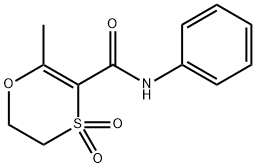
Chemical Properties
Oxydisulfoton is a white corrosive solid.
Definition
ChEBI: An anilide obtained by formal condensation of the amino group of aniline with the carboxy group of 2-methyl-5,6-dihydro-4,4-dioxo-1,4-oxathiine-3-carboxylic acid. A fungicide for the control of rust diseases on ornamentals, cereals and nursery trees as wel
as fairy rings on turf.
Agricultural Uses
Fungicide: Registered as a foliar systemic fungicide for use
against rust on carnations and greenhouse geranium. Not
approved for use in EU countries. Registered for use in
the U.S. and Canada
Trade name
CARBOJECT®[C]; DYNAM®; F461®;FUNGISOL®[C]; PLANTVAX®; PLANT WAX®;
VITAVEX®
First aid
If this chemical gets into the eyes, remove any
contact lenses at once and irrigate immediately for at least
15 minutes, occasionally lifting upper and lower lids. Seek
medical attention immediately. If this chemical contacts the
skin, remove contaminated clothing and wash immediately
with soap and water. Seek medical attention immediately.
If this chemical has been inhaled, remove from exposure,
begin rescue breathing (using universal precautions) if
breathing has stopped, and CPR if heart action has stopped.
Transfer promptly to a medical facility. When this chemical
has been swallowed, get medical attention. Give large
quantities of water and induce vomiting. Do not make an
unconscious person vomit. Do not induce vomiting when
formulations containing petroleum solvents are ingested。
Shipping
UN3077 Environmentally hazardous substances,
solid, n.o.s., Hazard class: 9; Labels: 9-Miscellaneoushazardous
material, Technical Name Required. UN1596 Dinotoanilines,
Hazard Class: 6.1; Labels: 6.1-Poisonous materials.
Incompatibilities
May react with strong oxidizers such as
chlorates, peroxides, and nitrates. Can become unstable in
acidic and alkaline media. Combustible; dust may form
explosive mixture with air. Corrosive, may attack some
metals, rubbers, and plastics.
Waste Disposal
Do not discharge into drains or
sewers. Dispose of waste material as hazardous waste using
alicensed disposal contractor to an approved landfill. Consult
with environmental regulatory agencies for guidance on acceptable disposal practices. If allowed, Incineration with
effluent gas scrubbing is recommended. Containers must be
disposed of properly by following package label directions or
by contacting your local or federal environmental control
agency, or by contacting your regional EPA office.
Uses
OXYCARBOXIN is effective against rust in grains and vegetables, and has both preventative and curative effects.
Production Methods
Oxycarboxin is commercially produced through a multi-step synthesis involving oxathiin ring formation and sulfone oxidation. It begins with the construction of the oxathiin ring system, which is derived from precursors such as 2-hydroxyethyl thiocarbamate and methyl-substituted aromatic compounds. These undergo cyclisation to form the dihydro-oxathiin core. The sulphur atom in the ring is then oxidized to a sulfone using oxidizing agents like hydrogen peroxide or peracids, enhancing the compound’s stability and biological activity. The final step involves acylation with phenyl isocyanate or similar reagents to introduce the carboxamide group. These reactions are typically carried out in organic solvents such as acetonitrile or toluene under controlled temperature and pH conditions to ensure high yield and purity.
Mechanism of action
Systemic with curative action. Inhibition of nucleic acid synthesis. Succinate DeHydrogenase Inhibitor.
Metabolic pathway
The oxathiin ring of the oxycarboxin undergoes a
glass-catalyzed ring-opening reaction resulting in a
simple step for hydrolytic removal of an acetyl group
to give 2-(vinylsulfonyl)acetanilide in aqueous solution.
The decomposition of oxycarboxin involves the
container and is surface-type dependent.
Pesticide Type
Fungicide; Metabolite