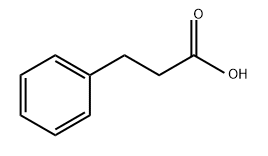
Chemical Properties
3-Phenylpropionic acid has a faint, sweet odor, somewhat balsamic and coumarin-like with a mildly sweet-sour,
vanilla-like taste.
Chemical Properties
white to off-white crystalline mass, powder or crystals and/or chunk
Occurrence
Reported found in raspberry, guava fruit, Vitis vinifera L., papaya, strawberry fruit, cinnamon, cassia leaf,
cheddar cheese, cocoa, beer, cognac, white wine, red wine, special wine, rose apple, mushroom, cloudberry, Boletus edulis, fresh
mango, licorice and labdanum.
Application
3-Phenylpropionic acid is rarely, if ever, used in perfumes,
but it finds some use in flavor compositions,
mainly as a fixative in Vanilla imitation, in
complexes as a sweetener, and in Cheese
imitation flavor for its mild pungency and
herbaceous character.
Definition
ChEBI: A monocarboxylic acid that is propionic acid substituted at position 3 by a phenyl group.
General Description
Hydrocinnamic acid forms complexes with uranium(VI) and has been investigated in aqueous solution by attenuated total reflection fourier transform infrared spectroscopy. Hydrocinnamic acids are the major rhizospheric compounds with known growth regulatory activity.
Pharmaceutical Applications
TMC207 (Bedaquiline) is a novel diarylquinoline belonging to a new class of anti-tuberculosis drugs.
TMC207 is synthesized in five steps from 3-phenylpropionic acid and para-bromoaniline. The quinoline ring is obtained thanks to a Vilsmeier–Haack reaction and the final condensation leads to four stereoisomers that are separated by column chromatography over silica gel and then by chiral chromatography to yield the desired (R,S) compound
[1].

Purification Methods
Crystallise the acid from *benzene, CHCl3 or pet ether (b 40-60o). Dry it in a vacuum. [Beilstein 9 H 508.]
References
[1] Villemagne, B., Crauste, C., Flipo, M., Baulard, A. R., Déprez, B., Willand, N. (2012). Tuberculosis: The drug development pipeline at a glance. European Journal of Medicinal Chemistry, 51, Pages 1-16.
https://doi.org/10.1016/j.ejmech.2012.02.033