Chemical Properties
White Crystalline Powder
Uses
Estradiol is the major estrogen secreted by the premenopausal ovary.
Uses
Potent mammalian estrogenic hormone produced by the ovary.
Definition
ChEBI: The 17beta-isomer of estradiol.
Hazard
A carcinogen (OSHA).
Biological Activity
Endogenous estrogen receptor (ER) agonist (K i values are 0.12 and 0.13 nM for ER α and ER β respectively). Also high affinity ligand at membrane estrogen GPR30 receptors.
Potential Exposure
The working environment may be
contaminated during sex hormone manufacture, especially
during the extraction and purification of natural steroid hormones; grinding of raw materials; handling of powdered
products and recrystallization. Airborne particles of sex
hormones may be absorbed through the skin, ingested or
inhaled. Enteric absorption results in quick inactivation of
sex hormones in the liver. The rate of inactivation is
decreased for the oral, alkylated steroid hormones (methyl
testosterone, anabolic steroids, etc.). Sex hormones may
accumulate and reach relatively high levels even if their
absorption is intermittent. Consequently, repeated absorption of small amounts may be detrimental to health.
Intoxication by sex hormones may occur in almost all the
exposed workers if preventive measures are not taken. The
effect in the industrial sector is more successful than
the agricultural one (chemical caponizing of cockerels by
stilbestrol implants and incorporation of estrogens in feed
for body weight gain promotion in beef cattle), where measures taken are summary and the number of cases of intoxication is consequently bigger
First aid
If this chemical gets into the eyes, remove any
contact lenses at once and irrigate immediately for at least
15 minutes, occasionally lifting upper and lower lids. Seek
medical attention immediately. If this chemical contacts the
skin, remove contaminated clothing and wash immediatelywith soap and water. Seek medical attention immediately.
If this chemical has been inhaled, remove from exposure,
begin rescue breathing (using universal precautions, including resuscitation mask) if breathing has stopped and CPR if
heart action has stopped. Transfer promptly to a medical
facility. When this chemical has been swallowed, get medical attention. Give large quantities of water and induce
vomiting. Do not make an unconscious person vomit
Shipping
UN3249 Medicine, solid, toxic, n.o.s., Hazard
Class: 6.1; Labels: 6.1-Poisonous materials
Application
β-Estradiol has been used:
for the in vitro maturation of bovine cumulus-oocyte complexes (COCs)
as a supplement in in vitro maturation medium (IVM), which is used as a control medium
in estrogen-induction assay
Acquired resistance
Estradiol is the most potent endogenous estrogen, exhibiting high affinity for the ER and high potency when administered
parenterally. When administered orally, estradiol is promptly conjugated in the intestine and oxidatively metabolized by the liver,
resulting in its low oral bioavailability and therapeutic effectiveness.
General Description
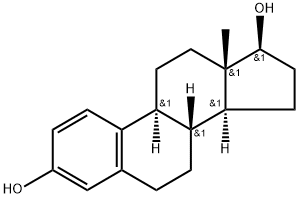
Estradiol, estra-1,3,5(10)-triene-3,17β-diol, is the most activeof the natural steroid estrogens. Although its 17β-OHgroup is vulnerable to bacterial and enzymatic oxidation toestrone, it can be temporarily protected as anester at C3 or C17, or permanently protected by adding a17α-alkyl group (e.g., 17α-ethinyl estradiol, the most commonlyused estrogen in oral contraceptives). The increasedoil solubility of the 17β-esters (relative to estradiol) permitsthe esters to remain in oil at the IM injection site for extendedperiods. These derivatives illustrate the principles of steroidmodification. Transdermal estradiolproducts avoid first-pass metabolism, allowing estradiol tobe as effective as oral estrogens for treating menopausalsymptoms. A new transdermal spray, Evamist, was approvedin 2007. Estradiol itself is typically not very effective orallybecause of rapid metabolism, but an oral formulation of micronizedestradiol that allows more rapid absorption of thedrug is available (Estrace). In addition to the oral and transdermalproducts, estradiol is also available in gel, cream, andvaginal ring formulations. The commercially available estradiolesters are the following:
Estradiol 3-acetate, USP (oral; vaginal ring)
Estradiol 17-valerate, USP (IM injection)
Estradiol 17-cypionate, USP (IM injection).
Biochem/physiol Actions
The major estrogen secreted by the premenopausal ovary. Estrogens direct the development of the female phenotype in embryogenesis and during puberty by regulating gene transcription and, thus, protein synthesis. It also induces the production of gonadotropins which, in turn, induce ovulation. Exposure to estradiol increases breast cancer incidence and proliferation.
Mechanism of action
The
most potent naturally occurring estrogen in mammals. It is synthesized
primarily in the ovary, and also in the testis, adrenal
gland and placenta, and to a limited extent by peripheral tissues
(e.g., liver, fat, and skeletal muscle) from androstenedione and
testosterone. It is responsible for the development of secondary
sex characteristics in the female at puberty (i.e., growth and
development of the vagina, uterus and fallopian tubes, enlargement
of the breasts, and growth and maturation of long bones).
Synthesis
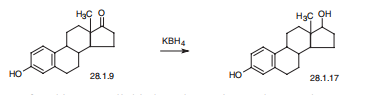
Estradiol, estra-1,3,5(10)-trien-3,17|?-diol (28.1.17), is most easily made by
reducing the keto-group of estrone by various reducing agents, in particular potassium
borohydride.
Purification Methods
17-Estradiol (previously known as -estradiol) is purified by chromatography on SiO2 (toluene/EtOAc 4:1) and recrystallised from CHCl3/hexane or 80% EtOH. It is stable in air, is insoluble in H2O, and is precipitated by digitonin. The UV has max at 225 and 280 nm. The diacetate [3434-88-6] has m 97-98o and forms leaflets from aqueous EtOH. The 3-benzoate crystallises from aqueous MeOH withm 193o and [] D 25 +58o to 63o (c 1, dioxane). [Meischer & Scholz Helv Chim Acta 20 263, 1237 1937, Biochem J 32 1273 1938, Oppolzer & Roberts Helv Chim Acta 63 1703 1980, Inhoffen & Zühlsdorff Chem Ber 7 4 1914 1941, Beilstein 6 IV 6611.]
Toxics Screening Level
The ITSL for estradiol has been changed from 0.04 μg/m3 to 0.1 μg/m3 based on an annual averaging time.