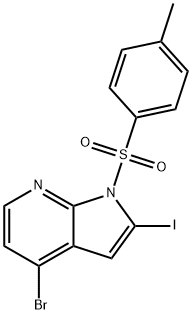
A hexane solution of n-butyllithium (1.6 M, 41.1 mL, 65.8 mmol) was added dropwise over 5 min to a solution of diisopropylamine (10.5 mL, 74.7 mmol) in 2-methyltetrahydrofuran (100 mL) under nitrogen protection, keeping the temperature at -78 °C. After stirring for 60 min, the resulting solution was transferred via cannula to a solution of 4-bromo-1-[(4-methylphenyl)sulfonyl]-1H-pyrrolo[2,3-b]pyridine (21 g, 60 mmol) in 2-methyltetrahydrofuran (700 mL). Stirring was continued at -78 °C for 90 min. Subsequently, solid iodine (21.3 g, 83.7 mmol) was added all at once and stirred at -78 °C for 60 min, after which it was slowly warmed to -10 °C. The reaction mixture was quenched with saturated aqueous ammonium chloride solution (1 L) and the organic layer was washed sequentially with saturated aqueous sodium bisulfite solution (750 mL) and saturated aqueous sodium chloride solution (50 mL). The organic layer was dried over anhydrous magnesium sulfate, filtered and concentrated under reduced pressure. The residue was purified by fast silica gel chromatography using a 20% tert-butyl methyl ether solution in heptane as eluent. The product grades were collected and concentrated to dryness to afford 4-bromo-2-iodo-N-tosyl-7-azaindole (27 g, 93%) as an off-white solid.1H NMR (400 MHz, DMSO-d6, 30 °C): δ 2.35 (s, 3H), 7.16 (s, 1H), 7.41-7.49 (m, 2H), 7.55 (d, J = 5.2 Hz, 1H), 7.95 (d, J = 8.4 Hz, 2H), 8.19 (d, J = 5.2 Hz, 1H). m/z: ES+ [M + H]+ 477.

![4-BROMO-1-[(4-METHYLPHENYL)SULFONYL]-1H-PYRROLO[2,3-B]PYRIDINE](/CAS/GIF/348640-07-3.gif)
