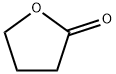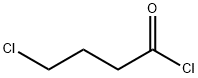
4635-59-0
| Name | 4-Chlorobutyryl chloride |
| CAS | 4635-59-0 |
| EINECS(EC#) | 225-059-1 |
| Molecular Formula | C4H6Cl2O |
| MDL Number | MFCD00000754 |
| Molecular Weight | 141 |
| MOL File | 4635-59-0.mol |
Chemical Properties
| Appearance | Clear colorless to yellow liquid |
| Melting point | -47 °C |
| Boiling point | 173-174 °C(lit.) |
| density | 1.26 g/mL at 25 °C(lit.) |
| vapor pressure | 3 mm Hg ( 20 °C) |
| refractive index | n |
| Fp | 163 °F |
| storage temp. | Store below +30°C. |
| solubility | Chloroform, DMSO (Sparingly), Ethyl Acetate (Slightly) |
| form | Liquid |
| color | Clear colorless to yellow |
| explosive limit | 5.5-11.7%(V) |
| Water Solubility | soluble in diethyl ether, ethanol, slightly soluble in water. |
| Sensitive | Moisture Sensitive |
| BRN | 773860 |
| Stability: | Hygroscopic, Moisture Sensitive |
| InChI | 1S/C4H6Cl2O/c5-3-1-2-4(6)7/h1-3H2 |
| InChIKey | CDIIZULDSLKBKV-UHFFFAOYSA-N |
| SMILES | ClCCCC(Cl)=O |
Safety Data
| Symbol(GHS) |    GHS05,GHS06,GHS09 |
| Signal word | Danger |
| Hazard statements | H290-H302-H314-H330-H400 |
| Precautionary statements | P273-P280-P301+P312-P303+P361+P353-P304+P340+P310-P305+P351+P338 |
| Hazard Codes | T,C |
| Risk Statements | |
| Safety Statements | |
| RIDADR | UN 3390 6.1/PG 1 |
| WGK Germany | 1 |
| RTECS | EM1406000 |
| Autoignition Temperature | 824 °F |
| Hazard Note | Toxic/Corrosive/Moisture Sensitive |
| TSCA | Yes |
| REACH Registrations | Active |
| HazardClass | 6.1 |
| PackingGroup | II |
| HS Code | 29159080 |
| Storage Class | 6.1A - Combustible acute toxic Cat. 1 and 2 very toxic hazardous materials |
| Hazard Classifications | Acute Tox. 2 Inhalation Acute Tox. 4 Oral Aquatic Acute 1 Eye Dam. 1 Met. Corr. 1 Skin Corr. 1A |
| Hazardous Substances Data | 4635-59-0(Hazardous Substances Data) |