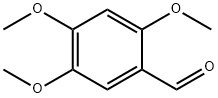
General Description
Beige powder.
Reactivity Profile
2,4,5-TRIMETHOXYBENZALDEHYDE(4460-86-0) is light sensitive. .
Air & Water Reactions
Insoluble in water.
Health Hazard
SYMPTOMS: Symptoms of exposure to related compounds are skin and gastrointestinal tract irritation, sensitization, blistering, nausea, vomiting, diarrhea, urinary tract irritation, initial excitement, convulsions and central nervous system depression.
Fire Hazard
Flash point data for this chemical are not available, but 2,4,5-TRIMETHOXYBENZALDEHYDE is probably combustible.
Description
2,4,5-Trimethoxybenzaldehyde (2,4,5-TMBA) is a natural cyclooxygenase-2 (COX-2) activity inhibitor that is present in carrot seeds (Daucus carota L.) and can be synthesised using Indonesia Sweet Flag (Acorus calamus) as a raw material. 2,4,5-TMBA may serve as a synthetic intermediate component for various pharmaceuticals. In addition, 2,4,5-TMBA is also considered a candidate drug for oral non-steroidal anti-inflammatory drugs (NSAIDs)
[1].
[1] LERRICK R I.
Synthesis of Nonsteroidal Anti-Inflammatory Drug (NSAID) 2,4,5-Trimethoxybenzaldehyde from Indonesian Calamus oil and Its In Silico Pharmacokinetic Study[J]. Canadian Journal of Chemistry, 2022, 20 1. DOI:10.1139/cjc-2022-0121.
Chemical Properties
white to light beige fine crystalline powder
Uses
2,4,5-Trimethoxybenzaldehyde is used in the synthesis of stilbene and hydrostibene derivatives as potential anticancer agents, inhibiting tubulin. Also used in the synthesis of HIV-RT inhibitors.
Uses
A selective Cox-2 inhibitor.
Definition
ChEBI: 2,4,5-trimethoxybenzaldehyde is a carbonyl compound.
Biological Activity
2,4,5-Trimethoxybenzaldehyde (2,4,5-TMBA) is a bitter principle present in plant seeds, leaves, and roots. 2,4,5-TMBA exhibits anti-inflammatory, anti-adipogenic, and immunomodulatory activities. 2,4,5-TMBA has significant inhibitory effects on COX-2 activity. COX-2 not only plays a crucial role in inflammatory reactions, but also participates in the adipogenesis of 3T3-L1 cells via its derivative 15-deoxy-D12,14 prostaglandin (PG)J2 (15d-PGJ2). Studies indicate that 2,4,5-TMBA further inhibits lipogenesis and promotes lipolysis in 3T3-L1 adipocytes. This is closely associated with 2,4,5-TMBA's downregulation of proteins critical for adipogenesis, including CCAAT/enhancer-binding proteins (C/EBP) α, β, δ, peroxisome proliferator-activated receptor (PPAR)γ2, acyl-CoA carboxylase (ACC), fatty acid synthase (FAS), and perilipin A in preadipocytes. In addition, carrot seed extracts rich in 2,4,5-TMBA exhibit immunomodulatory activity.