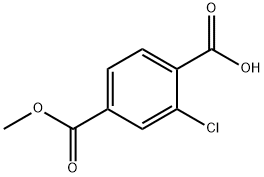
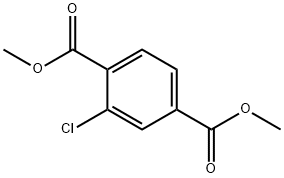
General procedure for the synthesis of 2-chloro-4-(methoxycarbonyl)benzoic acid from dimethyl 2-chloroterephthalate: dimethyl 2-chloroterephthalate (2.5 g, 11 mmol) was dissolved in dichloromethane (20 mL) and cooled to -5 °C. Boron tribromide (1 M in dichloromethane, 11 mL, 11 mmol) was slowly added dropwise with stirring. After the dropwise addition was completed, the reaction mixture was gradually warmed to room temperature and stirring was continued for 18 hours. Upon completion of the reaction, the mixture was poured into ice water, allowed to warm to room temperature, and then the pH was adjusted with solid sodium bicarbonate to 8. The aqueous phase was washed with ethyl acetate (50 mL), followed by acidification with 1 M hydrochloric acid, and extraction with ethyl acetate (160 mL). The organic phases were combined, washed with brine (80 mL), dried over anhydrous magnesium sulfate, filtered and concentrated under reduced pressure. The crude product was purified by silica gel column chromatography (120 g of silica gel, eluent was a 0-10% solution of methanol (containing 5% acetic acid) in dichloromethane) to give 2-chloro-4-(methoxycarbonyl)benzoic acid (1.5 g, 62% yield) as a white solid. Mass spectrum (electrospray positive ion mode) m/z 215 [M+H]+, (electrospray negative ion mode) m/z 213 [M-H]-; NMR hydrogen spectrum (400 MHz, DMSO-d6) δ: 13.79 (1H, broad single peak), 8.00-7.95 (2H, multiple peaks), 7.90-7.88 (1H, multiple peaks), 3.89 (3H (single peak).