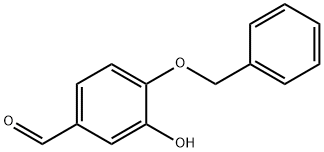
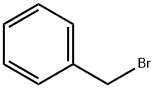
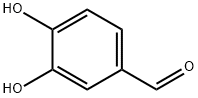
To a solution of 3,4-dihydroxybenzaldehyde (2.03 g, 14.7 mmol) in acetone (150 mL) was added potassium carbonate (K2CO3, 3.05 g, 22.1 mmol) and benzyl bromide (1.74 mL, 14.7 mmol). The reaction mixture was stirred under reflux conditions for 4 hours. Upon completion of the reaction, the reaction mixture was filtered through Celite? 535RVS and the filtrate was subsequently concentrated under reduced pressure. The residue was purified by column chromatography using toluene/ethyl acetate (13:1, v/v) as eluent to afford 4-(benzyloxy)-3-hydroxybenzaldehyde (2.12 g, 63% yield) as colorless prismatic crystals. The product characterization data were as follows: 1H NMR (300 MHz, CDCl3) δ 5.21 (2H, s), 5.77 (1H, s), 7.05 (1H, d, J = 8.2 Hz), 7.37-7.43 (7H, m), 9.86 (1H, s); 13C NMR (75 MHz, CDCl3) δ 71.2, 111.5, 114.4, 124.4, 127.9, 128.8, 128.9, 130.8, 135.2, 146.3, 150.9, 191.0; IR (ATR) νmax 3201, 1671, 1604, 1577, 1511, 1454, 1389, 1343, 1283, 1165, 1151, 1015 , 962, 874, 811, 786, 738, 698, 678 cm-1; EIMS m/z (relative intensity) 228 [M]+ (40), 91 (100); HR-EIMS m/z: [M]+ calculated C14H12O3 228.0786, measured 228.0789; melting point 120.0-122.0°C.