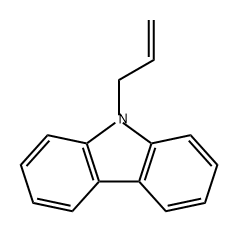
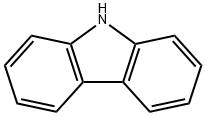
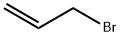
The general procedure for the synthesis of 9-allyl-9H-carbazole from carbazole and 3-bromo-1-propenyl was as follows: firstly, 1,2-polybutadiene was functionalized using S-[3-(9-carbazolyl)propyl] ester of thiobenzoic acid (16), which in turn led to the synthesis of 9-allylcarbazole (15). This was carried out as follows: carbazole (10.1 g, 0.057 mol) and potassium hydroxide (88% wt pellets, crushed, 7.1 g, 0.11 mol) were dissolved in 100 mL of DMSO and stirred at 50 °C for 30 min. Subsequently, allyl bromide (14.7 g, 0.118 mol) was added slowly and dropwise. After 15 minutes of reaction, the mixture was poured into a 500 mL dispensing funnel containing 100 mL of chloroform and washed five times with 200 mL of water. After evaporation of the solvent under reduced pressure at 60 °C, compound 15 was obtained with >99% purity as a dark brown viscous syrupy substance, which solidified to a solid on cooling (11.9 g, 0.057 mol, 100% yield). The product was analyzed by 1H NMR (300 MHz, CDCl3) showing δ=8.14-8.06 (m, 2H, carbazole), 7.49-7.32 (m, 4H, carbazole), 7.28-7.19 (m, 2H, carbazole), 6.04-5.90 (m, 1H, CH=CH2), 5.19-5.10 (m, 1H, Z-HCH= CH), 5.07-4.97 (m, 1H, E-HCH=CH), 4.92-4.85 (m, 2H, NCH2). 13C NMR (300 MHz, CDCl3) analysis showed δ=140.34, 132.27, 125.67, 122.90, 120.33, 119.00, 116.74, 108.74, 45.21. 108.74, 45.21.