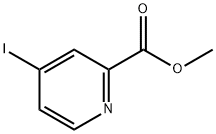
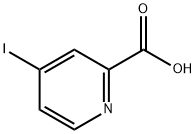
General procedure for the synthesis of methyl 4-iodopyridine-2-carboxylate from methanol and 4-iodopyridine-2-carboxylic acid: a few drops of concentrated sulfuric acid were added to a 500 mL solution of methanol containing 5 g (13.26 mmol) of 4-iodopyridine-2-carboxylic acid. The reaction mixture was refluxed overnight. After evaporation of the solvent, the residue was purified by chromatography to afford methyl 4-iodopyridine-2-carboxylate (14a) as a yellow solid (3.0 g, 86% yield).1H NMR (300 MHz, CDCl3) δ 8.49 (d, J=1.5 Hz,1H), 8.37 (d, J=5.4 Hz,1H), 7.85 (dd, J=1.6,5.2 Hz,1H), 4.00 (s,3H); MS (ESI+): 264.3 [M+H]+.
To a dry flask was added 14a (1 g, 3.8 mmol, 1 equiv), triphenylphosphine (79.7 mg, 0.3 mmol, 0.08 equiv), cuprous iodide (57.9 mg, 0.3 mmol, 0.08 equiv), palladium acetate (34.1 mg, 0.15 mmol, 0.04 equiv), and triethylamine (14 mL). The mixture was degassed with nitrogen and 3-butyn-1-ol (0.53 g, 7.6 mmol) was added and stirred at room temperature for 3 hours. The solvent was removed in vacuum to give a dark colored residue. Purification of the residue by chromatography afforded 14b (R=3-hydroxybut-1-ynyl) as a yellow oil (0.78 g, 100% yield).1H NMR (300 MHz, CDCl3) δ 8.66-8.63 (m,1H), 8.09-8.08 (m,1H), 7.43-7.40 (m,1H), 3.99 (s,3H) , 3.88-3.82 (m,2H), 2.72 (t,J=6.3Hz,2H); MS (ESI+): 206.4 [M+H]+.
A solution of 14b (R=3-hydroxybut-1-ynyl) above (0.78 g, 3.8 mmol) was mixed with 10% palladium carbon (0.4 g) in 40 mL of methanol. The flask containing the reaction mixture was purged with hydrogen (1 atm) and stirred overnight at room temperature. After filtration to remove the palladium, the filtrate was concentrated to give 14c (R=3-hydroxybutyl) as an oil (0.77 g, 97% yield).1H NMR (300 MHz, CDCl3) δ 8.60 (d,J=4.5 Hz, 1H), 7.97 (d,J=1.2 Hz, 1H), 7.29 (dd,J=1.6,5.0 Hz, 1H). 3.99 (s,3H), 3.67 (t,J=6.3Hz,2H), 2.72 (t,J=7.7Hz,2H), 1.81-1.69 (m,2H), 1.62-1.54 (m,2H); MS (ESI+): 210.4 [M+H]+.