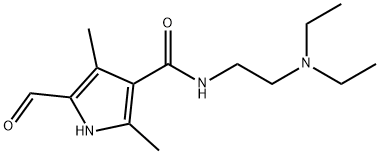
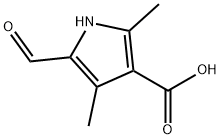
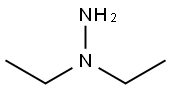
To a three-necked flask fitted with a thermometer was added 5-formyl-2,4-dimethyl-1H-pyrrole-3-carboxylic acid (3, 5.50 g, 32.7 mmol) and anhydrous DMF (13.1 mL), and cooled in an ice-salt bath to 0°C. Under stirring, a dichloromethane (78.4 mmol) solution of dicyclohexylcarbodiimide (DCC, 10.13 g, 49.0 mmol) was slowly added dropwise. mL) solution, keeping the reaction temperature between 0-2°C. Subsequently, 4-dimethylaminopyridine (DMAP, 1.65 g) and N1,N1-diethylethane-1,2-diamine (4, 5.03 mL, 35.9 mmol) were added and reacted at room temperature. The reaction progression was monitored by TLC (eluent: chloroform/methanol, v/v = 5:1). 59 h later, the reaction mixture was filtered, water was added to the filtrate, and extracted with dichloromethane (15 mL × 3). The organic layers were combined, washed with saturated brine (65.7 mL) and dried over anhydrous sodium sulfate. The filtrate was concentrated to give a solid, which was dissolved in a small amount of dichloromethane (5.0 mL). The resulting organic phase was washed with 5.0% aqueous citric acid (330 mL × 3) until TLC showed no product in the organic layer. The aqueous phase was alkalized to pH 8 with saturated aqueous sodium hydroxide and a large amount of aqueous sodium bicarbonate and extracted with dichloromethane (330 mL × 3). The organic layers were combined and concentrated to give a brown-red oily liquid. Further purification by column chromatography (eluent: petroleum ether/ethyl acetate, v/v = 3:1 to 1:1) afforded N-(2-(diethylamino)ethyl)-5-formyl-2,4-dimethyl-1H-pyrrole-3-carboxamide (10, 8.11 g, 86.3%) as a yellowish solid with a melting point of 153-154 °C (literature value 177-181 °C). Yield 42.5%. rf = 0.60 (eluent: chloroform/methanol, v/v = 5:1). 1H NMR (400 MHz, DMSO-d6) δ: 11.85 (s, 1H, NH), 9.54 (s, 1H, CHO), 7.36-7.38 (t, 1H, CONH), 3.24-3.29 (m, 2H, NHCH2) , 2.50-2.56 (m, 6H, 3 × N-CH2), 2.32 (s, 3H, 4-CH3), 2.37 (s, 3H, 2-CH3), 0.95-0.99 (t, 6H, 2 × CH3).