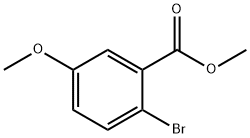
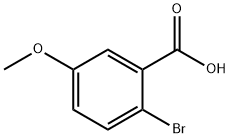
To a stirred solution of 2-bromo-5-methoxybenzoic acid (5.0 g, 21.6 mmol) in methanol (80 mL) was slowly added concentrated hydrochloric acid (2 mL). The reaction mixture was heated to reflux and stirred continuously for 18 hours. Upon completion of the reaction, the solution was cooled to room temperature and the solvent was subsequently evaporated under reduced pressure. Water (100 mL) was added to the residue and extracted with ethyl acetate (2 x 100 mL). The organic phases were combined and washed with saturated aqueous sodium bicarbonate to remove unreacted acid. The organic layer was dried over anhydrous magnesium sulfate, filtered and concentrated to give methyl 2-bromo-5-methoxybenzoate as a light brown oil (4.50 g, 85% yield). The product was confirmed by NMR hydrogen spectrum (300 MHz, CDCl3): δH 7.53 (1H, d, J=8.8 Hz, 3-H), 7.32 (1H, d, J=3.0 Hz, 6-H), 6.89 (1H, dd, J=3.0, 8.8 Hz, 4-H), 3.94 (3H, s, ArOCH3), 3.82 (3H, s. CO2CH3). Infrared spectroscopy (thin-film method) showed characteristic absorption peaks: 2951, 1732 (C=O), 1592, 1472, 1433, 1289, 1250, 1227, 1099, 1017, 975, 823, 792 cm-1. Thin-layer chromatography (unfolding reagent: hexane-ethyl acetate, 5:1) showed Rf-value of 0.58. All the data are in agreement with the literature reports ( Barhate, NB; Gajare, AS; Wakharkar, RD; Bedekar, AV Tetrahedron 1999,55,11127-11142).