Synthesis
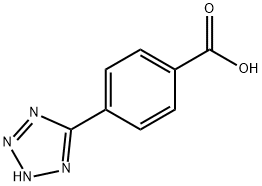
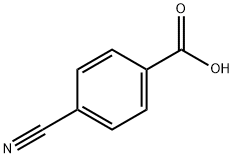
General procedure for the synthesis of 4-(1H-tetrazol-5-yl)benzoic acid from p-cyanobenzoic acid: p-cyanobenzoic acid (2 mmol), sodium azide (2.4 mmol, 1.2 eq.), and tetrabutylammonium bromide (2.4 mmol, 1.2 eq.) were added to a vial with a screw cap. The reaction mixture was stirred at 105 °C and the reaction progress was monitored by thin layer chromatography (TLC). Upon completion of the reaction, the mixture was cooled to room temperature and dissolved in deionized water (5 mL). Subsequently, the aqueous solution was acidified with 1 M hydrochloric acid to pH = 3. If precipitate formation was observed, the suspension was filtered and the filter cake was washed with deionized water to give pure 4-(1H-tetrazol-5-yl)benzoic acid. If no precipitate formed, the aqueous solution was extracted with ethyl acetate (3 x 4 mL). The organic phases were combined, washed with 1 M hydrochloric acid (3 x 4 mL), dried over anhydrous sodium sulfate, filtered and concentrated under reduced pressure to give pure 4-(1H-tetrazol-5-yl)benzoic acid.
References
[1] Journal of Chemical Research, 2013, vol. 37, # 11, p. 665 - 667
[2] Angewandte Chemie - International Edition, 2018, vol. 57, # 2, p. 511 - 515
[3] Angew. Chem., 2018, vol. 130, # 2, p. 520 - 524,5
[4] European Journal of Organic Chemistry, 2014, vol. 2014, # 2, p. 436 - 441
[5] European Journal of Organic Chemistry, 2014, vol. 2014, # 2, p. 436 - 441