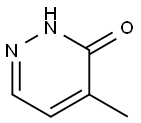
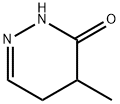
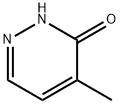
The general procedure for the synthesis of 4-methyl-3(2H)-pyridazinone using 4-methyl-4,5-dihydropyridazin-3(2H)-one as a starting material was as follows: bromine (27.4 mL, 0.535 mol) was dissolved in glacial acetic acid (70 mL), and the solution was added slowly dropwise to 4-methyl-4,5-dihydropyridazin-3(2H)-one (25.8 g, 0.232 mol) dissolved in glacial acetic acid (330 mL), maintaining a temperature of about 50 °C during the reaction. After dropwise addition was completed, the reaction mixture was heated to 80 °C and maintained for 2 hours. Upon completion of the reaction, the mixture was cooled to room temperature and subsequently concentrated to dryness under reduced pressure. The solid residue obtained was ground with ether and then the solid was dissolved in saturated sodium bicarbonate (NaHCO3) solution and extracted with ethyl acetate. The organic extracts were combined, dried with anhydrous sodium sulfate, filtered and concentrated to dryness under reduced pressure to give a light brown solid product (12.2 g, 48% yield). The structure of the product was confirmed by 1H NMR (400 MHz, CDCl3): δ 11.50 (1H, s), 7.71 (1H, d, J = 4.0 Hz), 7.10 (1H, d, J = 2.8 Hz), 2.23 (3H, d, J = 1.1 Hz) ppm.