Synthesis
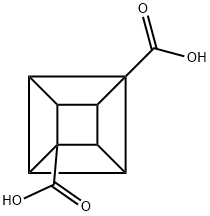
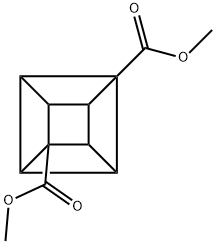
The general procedure for the synthesis of 1,4-cubanedicarboxylic acid from dimethyl cubane-1,4-dicarboxylate was as follows: a methanolic solution of 2.5 M NaOH (7.60 mL, 19.1 mmol, 1.05 eq.) was added slowly and dropwise to a tetrahydrofuran (THF,) solution of dimethyl cubane-1,4-dicarboxylate (4.00 g, 18.2 mmol) at room temperature. 125 mL) solution. The reaction mixture was stirred at room temperature for 14 hours. After completion of the reaction, the solvent was removed by evaporation under vacuum without heat. The residue was diluted with deionized water (45 mL) and extracted with chloroform (3 x 15 mL). The aqueous phase was acidified with 32% aqueous hydrochloric acid to pH 3. The acidified aqueous phase was re-extracted with chloroform (1 × 60 mL, 2 × 35 mL). All organic phases were combined and dried with anhydrous magnesium sulfate (MgSO4). The dried organic phase was evaporated from the solvent under reduced pressure to give 1,4-cubanedicarboxylic acid (3.46 g, 92% yield) as a colorless crystalline solid. The melting point of the product was determined to be 183-184.5 °C (literature value: 182-183 °C).1H NMR (200.1 MHz, CDCl3) data were as follows: δ 4.30-4.24 (6H, m, CH), 3.72 (3H, s, CH3), which is in agreement with the spectral data reported in the literature.
References
[1] Synthesis, 1995, # 5, p. 501 - 502
[2] Thermochimica Acta, 2010, vol. 499, # 1-2, p. 15 - 20
[3] Journal of Organic Chemistry, 1989, vol. 54, # 24, p. 5783 - 5788
[4] Organic Letters, 2014, vol. 16, # 16, p. 4094 - 4097
[5] Bioorganic and Medicinal Chemistry Letters, 2012, vol. 22, # 12, p. 4059 - 4063