Description
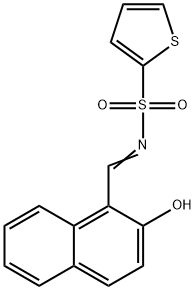
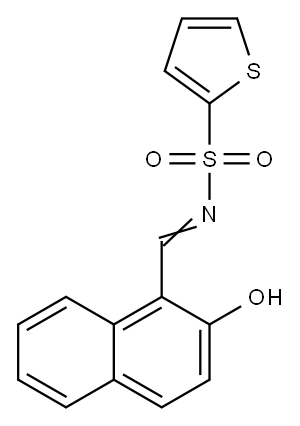
STF-083010 (307543-71-1) is a novel small molecule inhibitor of IRE1. It inhibits IRE1 endonuclease activity but not its kinase activity after endoplasmic reticulum stress.1-3 It displays significant antimyeloma activity in model human MM xenografts.1?STF-083010 induces apoptosis in pancreatic cancer cells and displays growth inhibition in a clonogenic growth assay in soft agar as well as in a xenograft?in vivo model of pancreatic cancer.4?Active?in vivo.
Uses
STF 083010 is an inhibitor of Ire1 endonuclease.
Biochem/physiol Actions
STF-083010 is a potent inhibitor of the ER transmembrane protein IRE1, which mediates the unfolded protein response. STF-083010 inhibits IRE1 endonuclease and mRNA splicing activity in response to endopasmic reticulum (ER) stress, but has no affect on the kinase activity of IRE1.
Synthesis
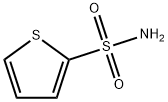
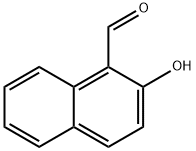
Tetraethyl orthosilicate (2.81 g, 13.5 mmol) was added to 2-thiophenesulfonamide (2.81 g, 13.5 mmol) and 2-hydroxy-1-naphthalene carboxaldehyde (2.00 g, 12.3 mmol) as a raw material and mixed in a 25 mL round bottom flask. A small distillation head was assembled and connected to the receiving flask. The reaction mixture was heated to 150 °C and maintained for 6 h, during which time the ethanol generated was collected in the receiving flask. After completion of the reaction, it was cooled to room temperature and the solid precipitated from the reaction flask was filtered and washed with 100 mL of ether. Purification by recrystallization (solvent was a 1:3 mixture of ethyl acetate and dichloromethane) afforded the target product, N-((2-hydroxynaphthalen-1-yl)methylene)thiophene-2-sulfonamide (STF-083010), as green crystals (2.21 g, 57% yield). The structure of the product was confirmed by 1H NMR, 13C NMR and HRMS (ESI-TOF).
in vitro
after endoplasmic reticulum stress both in vitro and in vivo, stf-083010 prevented ire1 endonuclease activity without affecting its kinase activity. treatment with stf-083010 exhibited significant antimyeloma activity in model human mm xenografts. similarly, compared with other similarly isolated cell populations, stf-083010 was preferentially toxic to freshly isolated human cd138 mm cells. on basis of the identification of this novel ire1 inhibitor, propose that the ire1-xbp1 axis is a promising target for anticancer therapy (especially in the context of mm) [1].
in vivo
the small molecule stf083010, identified by a high-throughput screen of compounds affecting ire1 activity, was capable of directly inhibiting the endonuclease function of ire1 without affecting its kinase activity. after treatment of mice harboring subcutaneous xenografts led to tumor shrinkage and multiple myeloma cells harvested from cancer patients died following exposure to stf083010, the antimyeloma therapeutic potential of stf083010 was convincingly demonstrated [2].
References
1) Papandreou?et al. (2011),?Identification of an Ire1α endonuclease specific inhibitor with cytotoxic activity against human multiple myeloma; Blood,?117?1311
2) Wang?et al. (2012),?Divergent allosteric control of the IRE1α endoribonuclease using kinase inhibitors; Nature Chem. Biol.,?8?982
3) Tam?et al. (2014),?Ire1 has distinct catalytic mechanisms for XBP/HAC1 splicing and RIDD; Cell Rep.,?9?850
4) Chien?et al. (2014),?Selective inhibition of unfolded protein response induces apoptosis in pancreatic cancer cells; Oncotarget,?5?4881