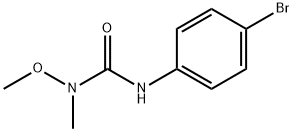
Potential Exposure
Preemergence substituted urea herbicide
used to control grasses and broadleaf weeds on flax,
groundnuts, potatoes, beans, soybeans, sunflowers, tomatoes,
and tobacco.
First aid
If this chemical gets into the eyes, remove any
contact lenses at once and irrigate immediately for at least
15 minutes, occasionally lifting upper and lower lids. Seek
medical attention immediately. If this chemical contacts the
skin, remove contaminated clothing and wash immediately
with soap and water. Seek medical attention immediately.
If this chemical has been inhaled, remove from exposure,
begin rescue breathing (using universal precautions) if
breathing has stopped, and CPR if heart action has stopped.
Transfer promptly to a medical facility. When this chemical
has been swallowed, get medical attention. Give large
quantities of water. Do not induce vomiting when formulations
containing petroleum solvents are ingested. Do not
make an unconscious person vomit.
Shipping
UN3021 Pesticides, liquid, flammable, toxic,
flash point ,23 C, Hazard Class: 3; Labels: 3-Flammable
liquid, 6.1-Poisonous materials. Technical Name Required.
UN2767 Phenyl urea pesticides, solid, toxic, Hazard Class:
6.1; Labels: 6.1-Poisonous materials, Technical Name
Required.
Incompatibilities
This organic bromine compound may
react with strong oxidizers such as chlorates, peroxides,
nitrates, permanganates, perchlorates, chlorine, fluorine,
etc. Keep away from strong acids.
Description
Metobromuron is a pre-emergence herbicide. It is moderately soluble in water, is quite volatile and there is a moderate risk that it may leach to groundwater. It is moderately persistent in soil systems and may also be persistent in water bodies, depending upon conditions. It has a low mammalian toxicity but has a high potential to bioaccumulate. It is classified as an irritant. It is moderately toxic to birds and most aquatic organisms and earthworms but it is not considered toxic to honeybees.
Chemical Properties
Colorless crystals. Soluble inalcohols; slightly soluble in water.
Chemical Properties
White crystalline solid or powder. Commercial
product may be dissolved in a flammable hydrocarbon
carrier.
Waste Disposal
Hydrolysis is not recommended
as a disposal procedure because of the generation
of the toxic products, 3,4-dichloroaniline and dimethylamine.
Incinerate in a unit with effluent gas scrubbing. Containers must be disposed of properly by following package
label directions or by contacting your local or federal
environmental control agency, or by contacting your
regional EPA office.
Uses
Metobromuron is a preemergence herbicide.
Definition
ChEBI: Metobromuron is a member of ureas.
Production Methods
The industrial synthesis of metobromuron begins with the preparation of 4-bromoaniline, which serves as the aromatic base. This compound undergoes condensation with dimethylcarbamoyl chloride or similar methylurea precursors to form the substituted urea backbone. The reaction is typically carried out in organic solvents such as acetone or toluene, under controlled temperature and pH conditions to ensure high yield and purity. The methoxy group is introduced via methylation of the urea nitrogen using agents like methyl iodide or dimethyl sulphate.
Agricultural Uses
Herbicide: Pre-emergence herbicide. Used against grasses
and broadleaf weed control on flax, groundnuts, potatoes,
beans, soybeans, sunflowers, tomatoes, and tobacco.
Pending for use in EU countries. Not registered for use
in the U.S. There are 24 global suppliers.
Trade name
C-3126®; CIBA 3126®; PATORAN®;
PATTONEX®
Mechanism of action
Photosynthetic electron transport inhibitor at the photosystem II.
Safety Profile
Moderately toxic by ingestion and intraperitoneal routes. An eye irritant. When heated to decomposition it emits toxic fumes of Brí and NOx