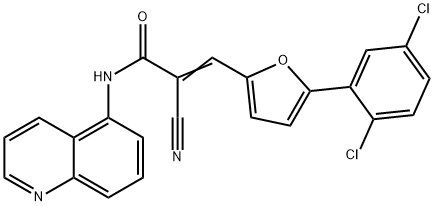
Uses
Potent, selective and cell permeable inhibitor of sirtuin 2 (SIRT2) (IC50=3.5μM). Rescues α-synuclein-mediated toxicity. Modifies inclusion morphology in a cellular model of Parkinson’s disease. Protects against dopaminergic cell death. Leads to an increase in acetylated tubulin.
Definition
ChEBI: 2-cyano-3-[5-(2,5-dichlorophenyl)-2-furanyl]-N-(5-quinolinyl)-2-propenamide is a member of quinolines.
Biological Activity
Selective inhibitor of SIRT2 (IC 50 = 3.5 μ M). Displays no activity at SIRT1 and SIRT3 at concentrations up to 40 μ M. Reduces α -synuclein-mediated toxicity in in vitro and in vivo models of Parkinson's disease.
Biochem/physiol Actions
AGK2 is a SIRT2 inhibitor. AGK2 rescues dopamine neurons from α-synuclein toxicity in Parkinson′s disease models. IC50 for SIRT2 = 3.5 uM. AGK2 is >15-fold more selective for SIRT2 than SIRT1 and SIRT3. AGK2 may be the most selective SIRT2 inhibitor available.
in vivo
AGK2 significantly reduces mortality and decreases levels of cytokines in blood (TNF-α: 298.3±24.6 vs 26.8±2.8 pg/mL, p=0.0034; IL-6: 633.4±82.8 vs 232.6±133.0 pg/mL, p=0.0344) and peritoneal fluid (IL-6: 704.8±67.7 vs 391.4±98.5 pg/mL, p=0.033) compare to vehicle control. AGK2 also suppresses the TNF-α and IL-6 production in the culturing splenocytes (TNF-α: 68.1±6.4 vs 23.9±2.8 pg/mL, p=0.0009; IL-6: 73.1±4.2 vs 49.6±3.0 pg/mL; p=0.0051)[4].
IC 50
SIRT2: 3.5 μM (IC50); SIRT1: 30 μM (IC50); SIRT3: 91 μM (IC50)
References
[1]. outeiro tf, kontopoulos e, altmann sm, et al. sirtuin 2 inhibitors rescue alpha-synuclein-mediated toxicity in models of parkinson's disease. science, 2007, 317(5837): 516-519.
[2]. scuderi c, stecca c, bronzuoli mr, et al. sirtuin modulators control reactive gliosis in an in vitro model of alzheimer's disease. front pharmacol, 2014, 5: 89.
[3]. rotili d, tarantino d, nebbioso a, et al. discovery of salermide-related sirtuin inhibitors: binding mode studies and antiproliferative effects in cancer cells including cancer stem cells. j med chem, 2012, 55(24): 10937-10947.