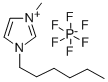
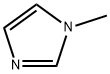
In a 1L Schlenk flask, 829 g (1.08 mol) of 1-chlorohexane and 260.5 g (2.16 mol) of N-methylimidazole were added, followed by 272.1 g (1.62 mol) of sodium hexafluorophosphate. The reaction mixture was stirred continuously at 70 °C for 2 weeks. Upon completion of the reaction, a white solid product was obtained by filtration through a protective gas glassware. The two phases formed were separated using a partition funnel and the lower yellow phase was collected. The phase was dried overnight at 60°C under high vacuum to give 1-hexyl-3-methylimidazole hexafluorophosphate in 87% yield. To qualitatively detect residual chloride in the product, about 1 ml of the product was mixed with about 5 ml of water and acidified with 2 drops of concentrated nitric acid. To this solution, 3-4 drops of silver nitrate solution were added and observed for the formation of silver chloride precipitate. No precipitate was formed indicating that there was no chloride residue in the product. The structure of the product was confirmed by NMR spectrum: 1H NMR (300 MHz, CDCl3) δ 9.9 (s, 1H, Ha), 7.26 (d, 1H, Hc), 7.24 (d, 1H, Hd), 4.1 (t, 2H, He), 3.9 (s, 2H, Hb), 1.6 (m, 2H, Hf), 1.2 (m, 6H, Hg, h, i) , 0.8 (t, 3H, Hj); 13C NMR (75 MHz, CDCl3) δ 137 (C1), 124-122 (C3, C4), 48 (C5), 35 (C2), 29-24 (C6-C8), 20 (C9), 13 (C10); 31P NMR (121 MHz) δ -143.08 (heptet, J = 710 Hz); 19F NMR (281 MHz) δ -72.5 (d, J = 710 Hz).