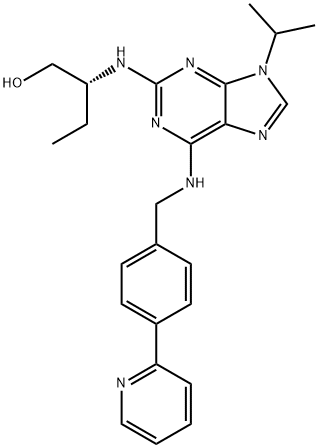
Description
CR8 (294646-77-8) is a second generation analog of roscovitine which inhibits cyclin-dependent kinases with increased potency, Cdk1/cyclin B, Cdk2/cyclin A, Cdk2/cyclin E, Cdk5, p25, and Cdk9/cyclin T, IC50s=0.09, 0.072, 0.041, 0.11 and 0.18 μM respectively.1,2 Acts as a molecular glue degrader that depletes cyclin K.3 CR8 displays neuroprotective effects in various models including traumatic brain injury.4
Uses
CR8, (R)-Isomer is a cell-permeable, ATP-binding pocket-targeting CDK/CK1 dual-specific inhibitor.
Biochem/physiol Actions
CR8 is a potent and selective inhibitor of cyclin dependent kinase (CDK1, 2, 5, 7, and 9). CR8 is a more potent pyridyl analogue of roscovitine (Cat. No. R7772). In comparison to roscovirtine, the compound gains in potency toward CK1, which is involved in amyloid-β formation. The R-CR8 enantiomer is slightly more potent than S. CR8 is around 30 times more potent at cellular assay then roscovitine. Acts as a molecular glue to induce cyclin K degradation.
in vivo
(R)-CR8 (5?mg/Kg; i.p.) results in a significant reduction in lesion size at 28 days in histological assessment[2].
| Animal Model: | Adult (10 to 12 weeks old) male Sprague-Dawley rats (310 to 330?g)[2] |
| Dosage: | i.p. |
| Administration: | 5?mg/Kg |
| Result: | Resulted in a significant reduction in lesion size. |
IC 50
Cdk1/cyclin B: 0.09 μM (IC50); cdk2/cyclin A: 0.072 μM (IC50); CDK2/cyclinE: 0.041 μM (IC50); Cdk5/p25: 0.11 μM (IC50); CDK7/cyclin H: 1.1 μM (IC50); CDK9/Cyclin T: 0.18 μM (IC50); CK1δ/ε: 0.4 μM (IC50)
References
Bettayeb et al. (2008), C8, a potent and selective, roscovitine-derived inhibitor of cyclin-dependent kinases; Oncogene, 27 5797
Bettayeb et al. (2010), CDK Inhibitors Roscovitine and CR8 Trigger Mcl-1 Down-Regulation and Apoptotic Cell Death in Neuroblastoma Cells; Genes Cancer, 1 369
Slabiki et al. (2020), The CDK inhibitor CR8 acts as a molecular glue degrader that depletes cyclin K; Nature, 585 293
Aubrecht et al. (2018), Comparing effects of CDK inhibitor and E2F1/2 ablation on neuronal cell death pathways in vitro and after traumatic brain injury; Cell Death Dis., 9 112