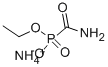
Chemical Properties
The pure product is a white crystalline solid with a slight minty aroma. Its mp is 175°C, relative density is 1.33, and vapor pressure is 5.33×10⁻⁴ Pa (25°C). Its solubility is: methanol 15.8%, ethanol 1.2%, xylene amide 0.14%, benzene 0.04%, acetone 0.03%, n-hexane 0.02%, chloroform 0.004%, and water 179%. It decomposes with acids, strong bases, and calcium and magnesium salts. It decomposes above 80°C, releasing ammonia. Its half-life in soil is approximately 7 days. It is slightly corrosive to brass.
Uses
FOSAMINE AMMONIUM used to control many woody and brush species on noncrop land
Production Methods
Commercial literature does not give step by step manufacturing detail for fosamine ammonium, but its production can be reliably summarised from structure. Industrial processes would typically synthesise the phosphonic acid backbone first, by reacting a suitable phosphite with an isocyanate or carbamoylating agent to form the carbamoylphosphonic acid ethyl ester. This intermediate is then neutralised with ammonia under controlled pH and temperature to yield the highly water soluble ammonium salt.
Mechanism of action
Slight systemic activity, contact action. Acts by preventing dormant tissues from becoming active and growing again.
Safety Profile
Mildly toxic by ingestion andinhalation. When heated todecomposition it emits very toxic fumes of NOx, POx, andNH3.
Environmental Fate
Soil. Fosamine is rapidly degraded to carbon dioxide by microorganisms in soil (Humburg et al., 1989). The reported half-life in soil is approximately 7 to 10 days (Hartley and Kidd, 1987; Worthing and Hance, 1991).
Plant. After a 2.5% application to multi?ora rose plant leaves, 19, 21, 22, and 43% of the applied amount was absorbed after 1, 4, 8, 16 and 32 days, respectively (Mann et al., 1986). Degrades rapidly in plants with a half-life of 2 to 3 weeks (H
Chemical/Physical. Fosamine-ammonium is stable as a dilute solution but decomposes in weak acidic media (Worthing and Hance, 1991), probably forming water-soluble salts.
Pesticide Type
Herbicide; Plant Growth Regulator