General steps:
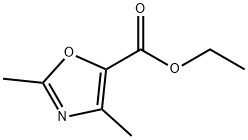
1. Hydrolysis reaction: ethyl 2,4-dimethyloxazole-5-carboxylate (1.8 g, 10.6 mmol) was dissolved in THF (20 mL) and cooled in an ice bath. To this solution was added a solution of LiOH-H2O (0.98 g, 23 mmol) in water (20 mL) followed by MeOH (10 mL). The reaction mixture was stirred in an ice bath and then gradually warmed to room temperature and stirred overnight. After completion of the reaction, the solution was concentrated in vacuum.
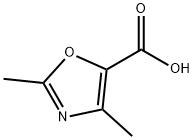
2. Acidification and isolation: the concentrated aqueous solution was cooled in an ice bath and the pH was adjusted slowly to 3 by addition of 2N HCl. The resulting white precipitate was collected by filtration and dried under vacuum to give 2,4-dimethyloxazole-5-carboxylic acid as a white powder (0.67 g, 45%).MS (ESI-POS): [M + H]+ = 142.
3. Amidation reaction: crude 2,4-dimethyloxazole-5-carboxylic acid (49 mg, 0.35 mmol) was mixed with piperazinylbenzimidazole (101 mg, 0.30 mmol), HATU (133 mg, 0.35 mmol), and DIEA (60 μL, 0.36 mmol) in NMP (6 mL), and stirred for 48 h at room temperature.
4. Post-treatment: after completion of the reaction, EtOAc (50 mL) and H2O (15 mL) were added to the mixture to separate the organic layer. The organic layer was washed sequentially with water (8 × 15 mL) and brine (20 mL), dried over anhydrous Na2SO4, filtered and concentrated.
5. Purification: the residue was purified by silica gel column chromatography using a gradient elution from 2% MeOH/CH2Cl2 to 3% MeOH/CH2Cl2 to afford the target amide compound (90 mg, 65%) as a white powder.1H NMR (300 MHz, CDCl3): δ = 9.38 (s, 1H), 7.97 (d, J = 8.4 Hz, 2H ), 7.52 (d, J = 8.4 Hz, 2H), 7.17 (t, J = 7.8 Hz, 1H), 7.11 (d, J = 7.9 Hz, 1H), 6.65 (d, J = 7.8 Hz, 1H), 4.01 (bs, 4H), 3.67 (bs, 4H), 2.49 (s, 3H), 2.39 (s, 3H), 1.37 (s MS (ESI-POS): [M + H]+ = 459. Calculated elemental analysis (C27H31N5O2-0.2CH2Cl2): C, 68.84; H, 6.67; N, 14.67. Measured values: C, 68.99; H, 6.87; N, 14.56.