Synthesis
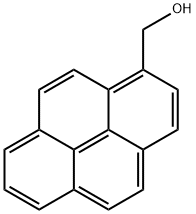
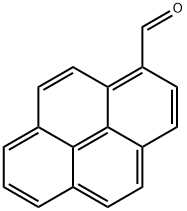
General procedure for the synthesis of 1-pyrenemethanol from 1-pyrenecarboxaldehyde: 1-pyrenecarboxaldehyde (1 g, 4.3 mmol) and dry tetrahydrofuran (20 mL) were placed in a round bottom flask. Sodium borohydride (165 mg, 4.3 mmol) was added in small portions and a small amount of methanol was added to promote dissolution (cumulative volume of methanol added was 10 mL) to obtain an orange solution. Upon completion of the reaction, the reaction was quenched with a 2% hydrochloric acid solution. Subsequently, the solvent was removed by distillation under reduced pressure. The resulting white powder was dissolved in dichloromethane, the organic phase was washed with water and dried with magnesium sulfate. The solvent was again removed by distillation under reduced pressure. Finally, the product was purified by silica gel column chromatography in 88% yield using dichloromethane as eluent. The structure of the product was confirmed by the following characterization: 1H NMR (300 MHz, CDCl3, 300K): δ (ppm) = 1.87 (s, 1H); 5.39 (s, 2H); 7.9-8.4 (m, 9H). 13C NMR {1H} (75 MHz, CDCl3, 300K): δ (ppm) = 64.03; 123.15 ; 124.87; 124.93; 125.13; 125.42; 125.45; 126.14; 126.19; 127.54; 127.63; 128.07; 128.97; 130.95; 131.42; 131.44; 133.94. ESI-MS: m/z = 254.97 [M + Na]+ , 214.99 [M-OH]+ (calculated values C17H12O: 232.09 (exact mass); 232.28 (molecular weight)).UV-Vis (DCM): λmax (nm) = 314; 327; 344.
References
[1] Molecules, 2011, vol. 16, # 8, p. 6950 - 6968
[2] Journal of the American Chemical Society,
[3] Journal of the American Chemical Society, 2008, vol. 130, p. 12846 - 12847
[4] Analytical Chemistry, 2018, vol. 90, # 2, p. 1402 - 1407
[5] Journal of Physical Chemistry A, 2003, vol. 107, # 40, p. 8363 - 8370