Chemical Properties
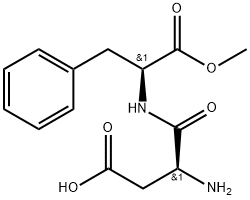
Aspartame (N-L-aspartyl-L-phenylalanine-1-methyl ester, 3-amino-N-(a-carbomethoxy-
phenethyl)-succinamic acid-N-methyl ester) is an intense sweetener widely
used in foods and beverages. Its solubility in water is approximately 10 g/L at room
temperature. Aspartame is not fully stable under common processing and storage
conditions of foods and beverages with the highest stability around pH 4.3.
Aspartame is about 200 times sweeter than sucrose with a clean, but slightly
lingering sweetness. It is used as the single sweetener, but often also in blends with other intense sweeteners owing to synergistic taste enhancement and taste quality
improvement often seen in such blends.
In the European Union, aspartame is approved as E 951 for a large number of
food applications. In the United States, it is approved as a multipurpose sweetener
for food and beverage uses and it is also approved in many other countries.
Chemical Properties
Aspartame has no odor, but has an intense sweet taste. It is a high intensity sweetener, about 160 to 200 times sweeter
than sucrose. Normal digestive processes convert aspartame to phenylalanine, aspartic acid and methanol. Metabolism of aspartame
in the body provides approximately 17 kJ (4 kcal)/g. The stability of aspartame is affected by moisture, pH and temperature. For a
detailed description of this compound, refer to Burdock (1997).
Production Methods
Aspartame is synthesized using the L enantiomer of phenylalanine. The L enantiomer is separated from the D enantiomer, the racemic mixture, by reacting it with acetic anhydride (CH32
Manufacturing Process
A solution of 88.5 parts of L-phenylalanine methyl ester hydrochloride in 100
parts of water is neutralized by the addition of dilute aqueous potassium
bicarbonate, then is extracted with approximately 900 parts of ethyl acetate.
The resulting organic solution is washed with water and dried over anhydrous
magnesium sulfate. To that solution is then added 200 parts of Nbenzyloxycarbonyl-
L-aspartic acid α-p-nitrophenyl, β-benzyl diester, and that
reaction mixture is kept at room temperature for about 24 hours, then at
approximately 65°C for about 24 hours. The reaction mixture is cooled to
room temperature, diluted with approximately 390 parts of cyclohexane, then
cooled to approximately -18°C in order to complete crystallization. The
resulting crystalline product is isolated by filtration and dried to afford β-
benzyl N-benzyloxycarbonyl-L-aspartyl-L-phenylalanine methyl ester, melting
at about 118.5-119.5°C.
To a solution of 180 parts of β-benzyl N-benzyloxycarbonyl-L-aspartyl-Lphenylalanine
methyl ester in 3,000 parts by volume of 75% acetic acid is
added 18 parts of palladium black metal catalyst, and the resulting mixture is
shaken with hydrogen at atmospheric pressure and room temperature for
about 12 hours. The catalyst is removed by filtration, and the solvent is
distilled under reduced pressure to afford a solid residue, which is purified by
recrystallization from aqueous ethanol to yield L-aspartyl-L-phenylalanine
methyl ester. It displays a double melting point at about 190°C and 245-
247°C.
Therapeutic Function
Sugar supplement
Biotechnological Production
Aspartame is produced from L-aspartic acid and L-phenylalanine and methanol or
alternatively L-phenylalanine methyl ester. The standard process uses common
chemical methods of peptide synthesis. Enzymatic coupling of the two amino
acids is also possible. N-formyl-L-aspartic acid and L- or D.L-phenylalanine methyl
ester can be condensed to aspartame by thermolysin-like proteases. The
formylated aspartame can be deformylated chemically or with a formylmethionyl
peptide deformylase to yield the sweetener.The enzymatic coupling does not
require L-phenylalanine but can start from the racemic product obtained in
chemical synthesis, and the remaining D-phenylalanine can be racemized again.
Production processes based on fermentation are available for the two main
components, aspartic acid and phenylalanine.
General Description
Asp-Phe methyl ester (aspartame, APM, ASP), a dipeptide ester, is made up of phenyl alanine and aspartic acid. Its genotoxic effects have been investigated. Its interaction with certain hydrocolloids has been studied.
Pharmaceutical Applications
Aspartame is used as an intense sweetening agent in beverage
products, food products, and table-top sweeteners, and in
pharmaceutical preparations including tablets, powder mixes,
and vitamin preparations. It enhances flavor systems and can be
used to mask some unpleasant taste characteristics; the approximate
sweetening power is 180–200 times that of sucrose.
Unlike some other intense sweeteners, aspartame is metabolized
in the body and consequently has some nutritive value: 1 g provides
approximately 17 kJ (4 kcal). However, in practice, the small
quantity of aspartame consumed provides a minimal nutritive
effect.
Biochem/physiol Actions
Asp-Phe methyl ester (Asp-Phe-OMe) is used as a synthetic sweeter, sugar substitute. Asp-Phe methyl ester is being studied for a variety of potential benefits as a nutrition supplement, such as the delay of osteoarthritis and modulation of rheumatoid factor activity. Asp-Phe methyl ester is being studied for its effect on thrombin activity and blood clotting.
Safety Profile
Human systemic effects byingestion: allergic dermatitis. Experimental reproductiveeffects. When heated to decomposition it emits toxicfumes of NOx.
Safety
Aspartame is widely used in oral pharmaceutical formulations,
beverages, and food products as an intense sweetener, and is
generally regarded as a nontoxic material. However, the use of
aspartame has been of some concern owing to the formation of the
potentially toxic metabolites methanol, aspartic acid, and phenylalanine.
Of these materials, only phenylalanine is produced in
sufficient quantities, at normal aspartame intake levels, to cause
concern. In the normal healthy individual any phenylalanine
produced is harmless; however, it is recommended that aspartame
be avoided or its intake restricted by those persons with
phenylketonuria.
The WHO has set an acceptable daily intake for aspartame at up
to 40 mg/kg body-weight. Additionally, the acceptable daily
intake of diketopiperazine (an impurity found in aspartame) has
been set by the WHO at up to 7.5 mg/kg body-weight.
A number of adverse effects have been reported following the
consumption of aspartame, particularly in individuals who
drink large quantities (up to 8 liters per day in one case) of
aspartame-sweetened beverages. Reported adverse effects include:
headaches; grand mal seizure;memory loss;gastrointestinal
symptoms; and dermatological symptoms. However, scientifically
controlled peer-reviewed studies have consistently failed to
produce evidence of a causal effect between aspartame consumption
and adverse health events. Controlled and thorough studies
have confirmed aspartame’s safety and found no credible link
between consumption of aspartame at levels found in the human
diet and conditions related to the nervous system and behavior, nor
any other symptom or illness. Aspartame is well documented to be
nongenotoxic and there is no credible evidence that aspartame is
carcinogenic.
Although aspartame has been reported to cause hyperactivity
and behavioral problems in children, a double-blind controlled trial
of 48 preschool-age children fed diets containing a daily intake of
38 ± 13 mg/kg body-weight of aspartame for 3 weeks showed no
adverse effects attributable to aspartame, or dietary sucrose, on
children’s behavior or cognitive function.
Environmental Fate
Aspartame is nontoxic. However, individuals with the rare,
genetic disease, phenylketonuria (PKU), cannot properly
metabolize phenylalanine. Such individuals are detected by
testing at birth and placed on special low-phenylalanine diets
to control their blood phenylalanine concentrations. Thus,
PKU individuals need to be aware that aspartame is a source of
phenylalanine.
Metabolic pathway
The rate of aspartame degradation is faster in a
phosphate buffer solution than in a citrate buffer
solution at the same pH and buffer concentration. The
primary mechanism by which aspartame degrades, the
formation of diketo piperazine, involves the
nucleophilic attack of carbonyl by the free amine,
which requires proton transfer.
storage
Aspartame is stable in dry conditions. In the presence of moisture,
hydrolysis occurs to form the degradation products L -aspartyl-Lphenylalanine
and 3-benzyl-6-carboxymethyl-2,5-diketopiperazine
with a resulting loss of sweetness. A third-degradation product is
also known, β-L-aspartyl-L-phenylalanine methyl ester. For the
stability profile at 258℃ in aqueous buffers.
Stability in aqueous solutions has been enhanced by the addition
of cyclodextrins, and by the addition of polyethylene glycol 400
at pH 2. However, at pH 3.5–4.5 stability is not enhanced by the
replacement of water with organic solvents.
Aspartame degradation also occurs during prolonged heat
treatment; losses of aspartame may be minimized by using processes
that employ high temperatures for a short time followed by rapid
cooling.
The bulk material should be stored in a well-closed container, in
a cool, dry place.
Incompatibilities
Differential scanning calorimetry experiments with some directly
compressible tablet excipients suggests that aspartame is incompatible
with dibasic calcium phosphate and also with the lubricant
magnesium stearate. Reactions between aspartame and sugar
alcohols are also known.
Regulatory Status
Accepted for use as a food additive in Europe and in the USA.
Included in the FDA Inactive Ingredients Database (oral powder for
reconstitution, buccal patch, granules, syrups, and tablets).
Included in nonparenteral medicines licensed in the UK. Included
in the Canadian List of Acceptable Non-medicinal Ingredients.
References
[1] ARBIND KUMAR CHOUDHARY Etheresia P. Revisiting the safety of aspartame.[J]. Nutrition reviews, 2017, 75 9: 718-730. DOI:
10.1093/nutrit/nux035[2] ISABELA FINAMOR . Chronic aspartame intake causes changes in the trans-sulphuration pathway, glutathione depletion and liver damage in mice[J]. Redox Biology, 2017, 11: Pages 701-707. DOI:
10.1016/j.redox.2017.01.019