Synthesis
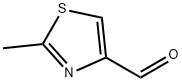
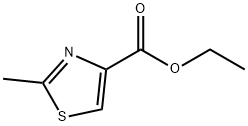
The general procedure for the synthesis of 2-methyl-4-thiazolecarboxaldehyde using ethyl 2-methylthiazole-4-carboxylate as starting material was as follows: to a solution of ethyl 2-methylthiazole-4-carboxylate (1.00 g, 5.8 mmol) in toluene (18 mL) was slowly added dropwise to a solution of diisobutylaluminum hydroxide in dichloromethane (11.1 mL, 1 M) at -78 °C. After the dropwise addition was completed, the reaction system was kept at -78 °C and stirring was continued for 4 hours. Subsequently, the reaction was quenched by the addition of acetic acid (0.46 mL) and concentrated by slowly warming the reaction mixture to 25 °C. The concentrated residue was treated with dichloromethane and Rochelle's salt with vigorous stirring until a clarified two-phase solution was formed (about 10 min). The organic and aqueous layers were separated, and the organic layer was washed sequentially with 10% NaHCO3 solution and saturated saline, then dried with anhydrous Na2SO4, filtered and concentrated. Finally, the residue was purified by silica gel column chromatography, using 14% ethyl acetate in hexane solution as eluent, to obtain the target product 2-methyl-4-thiazolecarboxaldehyde (0.28 g, 38% yield).
References
[1] Organic Letters, 2008, vol. 10, # 8, p. 1565 - 1568
[2] Angewandte Chemie - International Edition in English, 1997, vol. 36, # 1-2, p. 166 - 168
[3] Journal of the American Chemical Society, 1997, vol. 119, # 34, p. 7974 - 7991
[4] Organic Letters, 2012, vol. 14, # 24, p. 6354 - 6357
[5] Angewandte Chemie - International Edition, 2000, vol. 39, # 1, p. 209 - 213