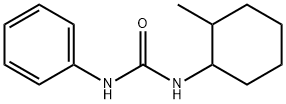
Chemical Properties
Colorless or white crystalline solid or powder.
Odorless. Commercial product is available as an emulsifi-
able concentrate.
Agricultural Uses
Herbicide: A pre-emergence herbicide used to control annual grasses, e.g., crabgrass, foxtail, and barnyard grass. Used on newly seeded or established turf and lawn grasses and as pre-emergence treatment to bare soil following spring seeding. Not listed for use in EU countries. Registered for use in the U.S.
Trade name
GREENFIELD®; GRO-TONE®[C]; H-1318®; TREY®; TUPERSAN®
Potential Exposure
A phenyl urea preemergence herbicide
used to control annual grasses (e. g., crabgrass, foxtail, and
barnyard grass) and on newly seeded or established turf
and lawn grasses and as bare soil treatment following
spring seeding.
First aid
If this chemical gets into the eyes, remove any
contact lenses at once and irrigate immediately for at least
15 minutes, occasionally lifting upper and lower lids. Seek
medical attention immediately. If this chemical contacts the
skin, remove contaminated clothing and wash immediately
with soap and water. Seek medical attention immediately.
If this chemical has been inhaled, remove from exposure,
begin rescue breathing (using universal precautions) if
breathing has stopped, and CPR if heart action has stopped.
Transfer promptly to a medical facility. When this chemical
has been swallowed, get medical attention. Give large
quantities of water. Do not induce vomiting when formula-
tions containing petroleum solvents are ingested. Do not
make an unconscious person vomit.
Shipping
UN2767 Phenyl urea pesticides, solid, toxic,
Hazard Class: 6.1; Labels: 6.1-Poisonous materials.
UN3002 Phenyl urea pesticides, liquid, toxic, Hazard
Class: 6.1; Labels: 6.1-Poisonous materials.
Description
Siduron is a selective pre-emergence herbicide. It has a moderate aqueous solubility, is volatile and, based on its chemical properties, it is moderately mobile with has a high potential to leach to groundwater. It is persistent in both soil and water systems. It has a relatively low mammalian toxicity and would not be expected to bioaccumulate. It is classified as an irritant. It is not highly toxic to birds, is moderately toxic to fish, algae and honeybees.
Waste Disposal
Incinerate in a unit with efflu-
ent gas scrubbing. Containers must be disposed of properly
by following package label directions or by contacting your
local or federal environmental control agency, or by
contacting your regional EPA office.
Uses
Selective preemergence herbicide used to control annual weed grasses and prevent
growth of crabgrass, foxtail and barnyard grass in turf, cereals and other food crops.
Definition
ChEBI:Siduron is a member of ureas.
Production Methods
The production of siduron typically begins with the synthesis of N,N-dimethylurea, which serves as a key intermediate. This compound is then reacted with 2,3-dihydro-1H-indene-1-carbonyl chloride or a similar indanone derivative under controlled conditions to form the final siduron molecule. The reaction involves nucleophilic substitution, where the urea nitrogen attacks the carbonyl carbon of the acid chloride, forming the desired urea linkage. The process may require solvent mediation and temperature control to optimise yield and purity.
General Description
Siduron is a pre-emergence and post emergence phenylurea herbicide used for the control of annual grass weeds. Its mode of action involves the inhibition of photosynthesis.
Mechanism of action
Selective, absorbed by roots and translocated. Photosynthetic electron transport inhibitor at the photosystem II.
Environmental Fate
Soil. A fungus and two Pseudomonas spp. isolated from soil degraded siduron to form
the major metabolites: 1-(4-hydroxy-2-methylcyclohexyl)-3-(p-hydroxyphenyl)urea, 1-(4-
hydroxy-2-methylcyclohexyl)-3-phenylurea and 1-(4-hydroxyphenyl)-3-(2-methycyclohexyl)urea (Belasco and Langsdorf, 1969).
Plant. After 8 days following absorption in barley plants, no metabolites were detected
(Splittstoesser and Hopen, 1968).