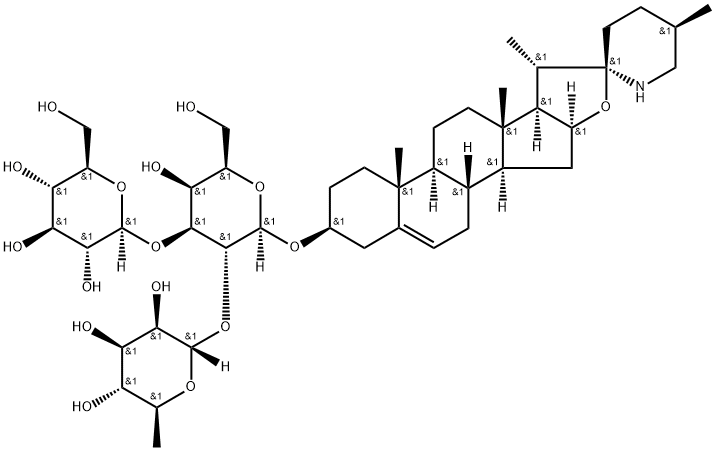
Description
This gly<:oalkaloid occurs in several species of Solanum including S. aviculare, S.
sodomeum, S. verbascifolium and S. xanthocarpum. The alkaloid crystallizes
from 80 per cent EtOH with 4.5 H20, m.p. 245-250°C (dec.), the anhydrous
form being obtained from absolute MeOH. It has [α]25D - 68° (EtOH) and
yields the following salts: hydrochloride, m.p. 265°C; picrate, m.p. 199-201 °C;
picrolonate, m.p. 230-loC and the acetyl derivative, m.p. l35-8°C. On alkaline
hydrolysis, the alkaloid gives solasodine and one mole each of galactose, glucose
and rhamnose. The solution in concentrated H2S04 eventually gives a crimson
colour with a brown fluorescence.
Chemical Properties
Soluble in hot ethanol and hot dioxane, slightly soluble in hot water and dilute acetic acid, insoluble in chloroform and ether. Derived from the fruit of Solanum aviculare Forst., a plant of the Solanaceae family.
Uses
α-Solasonine is a natural glycoalkaloid compound which has been shown to inhibit Gli-mediated transcritional activity.
Definition
ChEBI: Solasonine is an azaspiro compound, an oxaspiro compound and a steroid.
Purification Methods
Solasonine crystallises from aqueous 80% dioxane or MeOH in needles. [Bell & Briggs J Chem Soc 1 1942, Briggs et al. J Chem Soc 4645 1961, Briggs et al. J Chem Soc 2848 1963.] The picrate crystallises from 30% aqueous EtOH with m 197-198o(dec) [Briggs & Cambie J Chem Soc 1422 1958]. [Beilstein 27 III/IV 2006.]
References
Oddo et a/., Gazzetta, 35, 27 (1905)
Levi., J. Soc. Chem. Ind., 49, 395T (1930)
Briggs., Nature, 144, 247 (1939)
Briggs.,J. Chem. Soc., 3 (1942)
Briggs, Vining., ibid, 2809 (1953)
Hayes, Scaforth., ibid, 74S (1963)