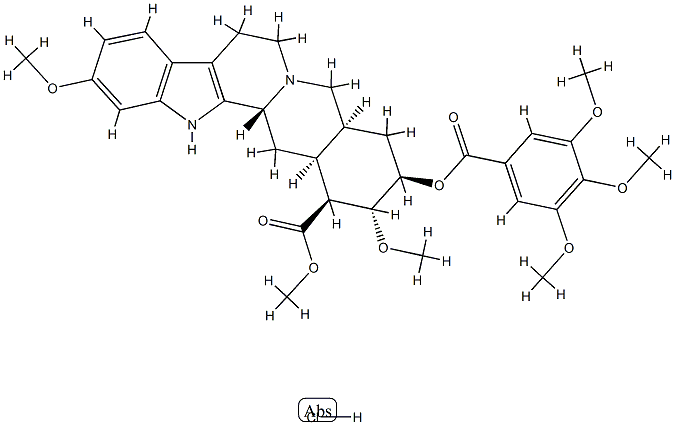
[1] Antkiewicz-Michaluk L, et al. Withdrawal from repeated administration of a low dose of reserpine induced opposing adaptive changes in the noradrenaline and serotonin system function: a behavioral and neurochemical ex vivo and in vivo studies in the rat. Prog Neuropsychopharmacol Biol Psychiatry. 2015 Mar 3;57:146-54. DOI:
10.1016/j.pnpbp.2014.10.009[2] Hong B, et al. Reserpine Inhibit the JB6 P+ Cell Transformation Through Epigenetic Reactivation of Nrf2-Mediated Anti-oxidative Stress Pathway. AAPS J. 2016 May;18(3):659-69. DOI:
10.1208/s12248-016-9901-6[3] Sreemantula S, et al. Reserpine methonitrate, a novel quaternary analogue of reserpine augments urinary excretion of VMA and 5-HIAA without affecting HVA in rats. BMC Pharmacol. 2004 Nov 16;4:30. DOI:
10.1186/1471-2210-4-30[4] Pfeiffer CJ, et al. Reserpine-induced gastric ulcers: protection by lysosomal stabilization due to zinc. Eur J Pharmacol. 1980 Feb;61(4):347-53. DOI:
10.1016/0014-2999(80)90073-4[5] Li GJ, et al. Preventive Effect of Polysaccharide of Larimichthys crocea Swim Bladder on Reserpine Induced Gastric Ulcer in ICR Mice. Korean J Physiol Pharmacol. 2014 Apr;18(2):183-90. DOI:
10.4196/kjpp.2014.18.2.183[6] Gupta MB, et al. Mechanism of ulcerogenic activity of reserpine in albino rats. Eur J Pharmacol. 1974 Jul;27(2):269-71. DOI:
10.1016/0014-2999(74)90159-9[7] Park BK, et al. Antidepressant-Like Effects of Gyejibokryeong-hwan in a Mouse Model of Reserpine-Induced Depression. Biomed Res Int. 2018 Jun 26;2018:5845491. DOI:
10.1155/2018/5845491[8] El-Marasy SA, et al. Anti-depressant effect of cerebrolysin in reserpine-induced depression in rats: Behavioral, biochemical, molecular and immunohistochemical evidence. Chem Biol Interact. 2021 Jan 25;334:109329. DOI:
10.1016/j.cbi.2020.109329