Chemical Properties
WHITE TO LIGHT BEIGE CRYSTALS OR CRYSTAL. POWDER
Description
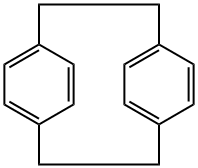
[2.2]Paracyclophane is used as an intermediate in organic synthesis or as a reagent in chemical reactions. It serves as the structural backbone of 4-toluenesulfinyl [2.2]p-dicyclohexane and can be used in the synthesis of various mono- and disubstituted [2.2]p-dicyclohexane derivatives. It can also be used for the preparation of metal complexes, and the interaction of the Ag+ cation with the cation -π of [2.2]paracyclophane can be used to synthesise Ag+ - [2.2]paracyclophane complexes using the Ag+ cation. The complex is formed by binding the cation Ag+ to three carbon atoms on a benzene ring of the [2.2]paracyclophane ligand using a cation-π interaction[1].
Characteristics
Parylene N has excellent electronic properties, including low dissipation factor, high dielectric strength, and low dielectric constant. These properties are beneficial for applications involving printed circuit boards and signal transmission. The extra chlorine in Parylene D results in slightly higher operating temperature for Parylene D relative to Parylene C.
Uses
2,2]-Paracyclophane is the raw material for the synthesis of parylene which is widely used in microelectronic integrated circuit.
Application
Parylene N, also known as [2.2]Paracyclophane, is a poly-p-xylene variant. Polyparacyclophane has been widely used as a coating for medical devices. It has also been used to make films and porous membranes on which cells can grow.Exposure of Parylene N films to UV light under aerobic conditions leads to the formation of aldehyde and carboxylic acid groups near the film surface. At the maximum exposure dose, the oxygen concentration on the surface of the Parylene N film is approximately 13% and decreases exponentially with depth. This suggests that further modelling and optimisation of this process could be used to regulate the surface concentration of oxygenated substances in poly(parylene) to optimise adhesion and wettability, or for chemical binding to other groups.[2]
Flammability and Explosibility
Notclassified
Synthesis
In a 1L three-necked flask, 45g of potassium carbonate, 58g of potassium fluoride and 1.2g of benzyltriethylammonium chloride were added and dissolved in 500mL of water. A solution of 61.8g of (2-chloro-4-chloromethylbenzyl)trimethylsilane dissolved in
Purification Methods
Purify it by recrystallisation from AcOH. 1H-NMR �: 1.62 (Ar-H) and -1.71 (CH2) [Waugh & Fessenden J Am Chem Soc 79 846 1957, IR and UV: Cram et al. J Am Chem Soc 76 6132 1954, Cram & Steinberg J Am Chem Soc 73 5691 1951. It complexes with unsaturated compounds: Cram & Bauer J Am Chem Soc 81 5971 1959, Syntheses: Brink Synthesis 807 1975, Givens et al. J Org Chem 44 16087 1979, Kaplan et al. Tetrahedron Lett 3665 1976]. [Beilstein 5 IV 2223.]
References
[1] DR. PETR VA?URA; Dr. T U; Prof David Sykora. Interaction of the Silver(I) Cation with [2.2]Paracyclophane: Experimental and Theoretical Study[J]. ChemistrySelect, 2022. DOI:10.1002/slct.202203008.