Description
Atraton is an obsolete herbicide that was used for clearing vegetation in non-agricultural areas. It is moderately soluble in water and is non-volatile. It may be persistent in soil systems depending on conditions. Little information is known regarding its ecotoxicity. It is moderately toxic to mammals if ingested and is a recognised irritant.
Uses
Atraton is a toxic herbicide and an environmental contaminants.
Definition
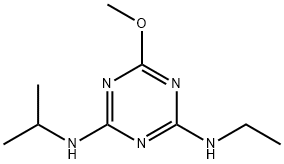
ChEBI: A diamino-1,3,5-triazine that is N-ethyl-N'-(propan-2-yl)-1,3,5-triazine-2,4-diamine substituted by a methoxy group at position 6. It is an agrochemical used as a herbicide.
Production Methods
Atraton is commercially produced via a process that involves the alkylation of atrazine derivatives, specifically through the methoxylation of atrazine to introduce a methoxy group at the 6-position of the triazine ring. This is typically achieved by reacting 2-chloro-4-ethylamino-6-isopropylamino-1,3,5-triazine with methanol under basic conditions. The resulting compound, 2-methoxy-4-ethylamino-6-isopropylamino-s-triazine, is purified and crystallized to yield technical-grade atraton.
General Description
Atraton is a triazine herbicide intended to control weeds in a variety of crops. Triazines herbicides act by inhibiting photosynthesis in all organisms with oxygen-evolving photosystems.
Mechanism of action
Non-selective, systemic absorbed by foliage and roots, inhibits photosynthesis and other enzyme processes