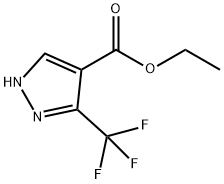
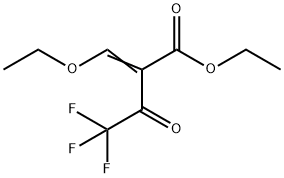
The general procedure for the synthesis of ethyl 3-trifluoromethylpyrazole-4-carboxylate from ethyl 2-(ethoxymethylene)-4,4,4-trifluoro-3-oxobutanoate was as follows: hydrazine hydrate (10 g, 0.199 mol) was dissolved in ethanol (400 mL) and the solution was cooled to 0 °C. A solution of ethyl 2-(ethoxymethylene)-4,4,4-trifluoro-3-oxobutanoate (47.03 g, 0.19 mol) in ethanol (200 mL) was added dropwise to this cooled solution over 90 min. The reaction mixture was kept at 0 °C. Subsequently, the reaction solution was slowly warmed to room temperature and stirred continuously for 3 hours. Upon completion of the reaction, the mixture was concentrated to dryness. The resulting residue was dispersed in boiling cyclohexane (200 mL) and then cooled to room temperature. The precipitate was collected by filtration and washed with cyclohexane. Finally, the product was dried under vacuum at 75 °C to afford ethyl 3-trifluoromethylpyrazole-4-carboxylate (compound 3f) as a yellow powder (38.67 g, 95% yield). The melting point of the product was 145 °C. 1H NMR (CDCl3) data: δ 1.40 (t, 3H, J = 7.0 Hz), 4.39 (q, 2H, J = 7.0 Hz), 8.26 (s, 1H), 13.2 (s (br), 1H). 13C NMR (CDCl3) data: δ 14.0, 61.2, 113.4, 121.0 ( q, J = 268 Hz), 135.3, 142.0 (q, J = 38 Hz), 160.8. High-resolution mass spectrometry (HRMS) analysis: calculated value of 207.0381 for C7H7F3N2O2-H; measured value of 207.0377.