Example 1: Synthesis of N-(2-(2,6-dichlorophenyl)-2H-pyrazolo[4,3-c]pyridin-4-yl)cyclopropanecarboxamide
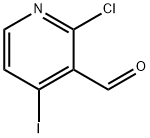
Step 1: Preparation of 2-chloro-4-iodonicotinaldehyde
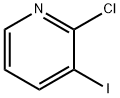
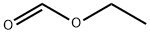
A solution of 2-chloro-3-iodopyridine (5.0 g, 21 mmol) in anhydrous THF (30 mL) was slowly added dropwise to a solution of lithium diisopropylammonium (15 mL, 30 mmol) in anhydrous THF (50 mL) that was pre-cooled to -78 °C. The reaction mixture was stirred continuously at -78 °C for 3 hours. Subsequently, ethyl formate (4.0 g, 54 mmol) was added to the reaction system and stirring was continued at the same temperature for 1.5 hours. Upon completion of the reaction, the reaction was quenched by the addition of water (10 mL), after which the mixture was slowly warmed to room temperature. THF was removed by distillation under reduced pressure after addition of 2 M HCl (50 mL).The aqueous phase was extracted with ethyl acetate (2 x 50 mL). The organic phases were combined, washed with brine, dried over anhydrous Na2SO4 and concentrated under reduced pressure. The crude product was purified by silica gel column chromatography (eluent: ether/petroleum ether=1:4) to afford the target compound 2-chloro-4-iodonicotinaldehyde as a yellow solid (3.0 g, 54% yield).
NMR (500MHz, CDCl3): δ10.22 (s, 1H), 8.09 (d, J=5.0Hz, 1H), 7.95 (d, J=5.0Hz, 1H).