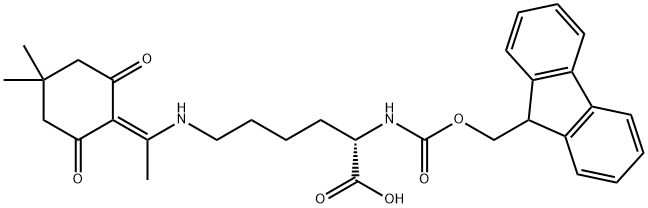
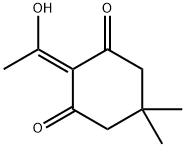
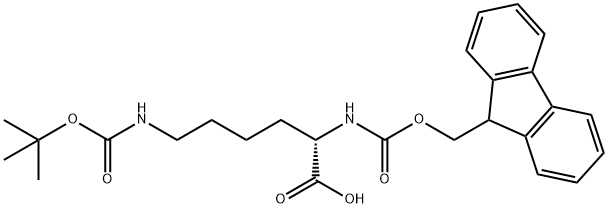
GENERAL STEPS: N-α-Fmoc-N-ε-Boc-L-lysine (5.66 g, 12.1 mmol) was dissolved in 4 M HCl/dioxane (120 mL) and stirred at room temperature for 2 h to remove the tert-butoxycarbonyl protecting group. Upon completion of the reaction, the solvent was removed by concentration under reduced pressure. The resulting residue was dissolved in ethanol (60 mL) followed by the addition of 2-(1-hydroxyethylidene)-5,5-dimethylcyclohexane-1,3-dione (3.36 g, 18.4 mmol) and N,N-diisopropylethylamine (6.2 mL, 35.6 mmol). The reaction mixture was heated to reflux for 17 hours. After cooling to room temperature, the solvent was removed by concentration under reduced pressure. The residue was dissolved in ethyl acetate (300 mL), washed sequentially with 1 M HCl (100 mL) and saturated saline (100 mL), and the organic phase was dried over anhydrous sodium sulfate, filtered and concentrated. The crude product was purified by silica gel column chromatography (0.5%-3% methanol/dichloromethane gradient elution) to afford N-fluorenylmethoxycarbonyl-N'-[1-(4,4-dimethyl-2,6-dioxocyclohexylidene)ethyl]-L-lysine (2.64 g, 41% yield) as a white solid. The spectral data of the product were consistent with those reported in the literature.1H NMR (500 MHz, CDCl3): δ 13.31 (br s, 1H), 7.75 (d, J = 7.8 Hz, 2H), 7.59 (t, J = 7.8 Hz, 2H), 7.38 (t, J = 7.8 Hz, 2H), 7.31-7.28 (m, 2H), 5.73 (d, J = 8.0 Hz, 1H), 4.48-4.45 (m, 1H), 4.37 (d, J = 7.1 Hz, 2H), 4.20 (t, J = 7.1 Hz, 1H), 3.43-3.40 (m, 2H), 2.55 (s, 3H), 2.36 (s, 4H), 2.00-1.50 (m, 6H), 1.01 (s, 6H). HR-MS (m/z, FAB): calculated C31H37N2O6 ([M+H]+), 533.2652; measured, 533.2643.