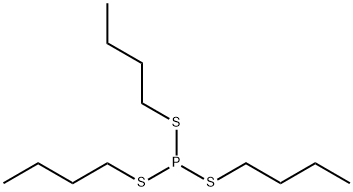
Chemical Properties
Nearly colorless liquid. Insoluble in water; soluble in a variety of organic
solvents.
Uses
Organophosphate pesticide used in the agriculture industry
General Description
Emulsifiable oil.
Reactivity Profile
Organothiophosphates, such as MERPHOS, are susceptible to formation of highly toxic and flammable phosphine gas in the presence of strong reducing agents such as hydrides. Partial oxidation by oxidizing agents may result in the release of toxic phosphorus oxides.
Hazard
Cholinesterase inhibitor.
Production Methods
The industrial production of merphos begins with the preparation of phosphorotrithioic acid or its reactive derivatives, which serve as the phosphorus-containing core. This compound undergoes esterification with butyl alcohols (typically n-butanol or isobutanol) under controlled conditions, often in the presence of acid catalysts such as sulphuric acid or p-toluenesulfonic acid. The reaction is carried out in organic solvents like toluene or xylene, with temperature and pH carefully regulated to ensure complete conversion and minimise side reactions. The resulting tributyl ester is purified through distillation or solvent extraction to remove unreacted materials and achieve the desired chemical purity.
Mechanism of action
Merphos, as a defoliant pesticide, works by causing a controlled injury to the leaf tissue of cotton plants. This injury triggers a stress response in the plant, leading to the production of ethylene, a plant hormone that plays a crucial role in leaf senescence and abscission.
Environmental Fate
Merphos is adsorbed strongly to soil and oxidized to
S,S,S-tributyl phosphorotrithioate (DEF). The Koc estimated for
merphos is theoretically 62 000; accordingly, merphos would
be immobile in soil.
In water, merphos will be oxidized to DEF. The fact that
merphos is expected to adsorb strongly to particulate matter in
the water column, apparently did not impede its oxidation.
In the atmosphere, merphos will exist as an aerosol and be
removed by gravitational settling and readily oxidized to DEF.
Vapor-phase merphos will react with photochemically
produced hydroxyl radicals, with an estimated half-life of 4.9 h.
Pesticide Type
Plant Growth Regulator; Herbicide