Description
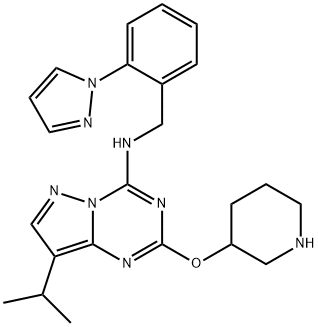
LDC-4297 is an inhibitor of cyclin-dependent kinase 7 (CDK7; IC50 = <5 nM). It is selective for CDK7 over CDK4, CDK6, and CDK9 (IC50s = >10, >10, and 1.71 μM), however, it also inhibits CDK2 and CDK1 (IC50s = 6.4 and 53.7 nM, respectively). LDC-4297 (10-100 nM) induces apoptosis in A549, HeLa, and HCT116 cancer cells in a concentration-dependent manner. It inhibits human cytomegalovirus (HCMV) replication in human fibroblasts (EC50 = 24.5 nM). LDC-4297 also reduces replication of Herpesviridae, Adenoviridae, Poxviridae, Retroviridae, and Orthomyxoviridae family viruses (EC50s = 0.02-1.13 μM).
Uses
Cyclin-dependent protein kinase 7 (CDK7) is involved with a broad range of regulatory roles in cell cycle and transcription, which is essential for viral replication. LDC 4297 is a CDK7 inhibitor that can be used to develop antiviral drugs.
Definition
ChEBI: LDC4297 is a pyrazolotriazine that is pyrazolo[1,5-a][1,3,5]triazine substituted by a piperidin-3-yloxy group, [2-(1H-pyrazol-1-yl)benzyl]nitrilo group and an isopropyl group at positions 2, 4 and 8 respectively. It is a potent and selective CDK7 inhibitor and exhibits antiviral activity. It has a role as an EC 2.7.11.22 (cyclin-dependent kinase) inhibitor, an apoptosis inducer, an antineoplastic agent and an antiviral agent. It is a pyrazolotriazine, a member of pyrazoles, a member of piperidines, a secondary amino compound and an aromatic ether.
in vivo
LDC4297 (100 mg/kg; p.o. once) shows promising pharmacokinetic analyses[1].
| Animal Model: | CD1 mice[1] |
| Dosage: | 100 mg/kg |
| Administration: | Oral gavage; 100 mg/kg once |
| Result: | Showed a half-life of 1.6 h, and the time to a mean peak plasma concentration of 1,297.6 ng/mL is reached 0.5 h after administration with a continued presence in plasma for at least 8 h and a bioavailability of 97.7%.
|
IC 50
CDK7: 0.13 nM (IC50); HSV-1: 0.02 μM (EC50); HSV-2: 0.27 μM (EC50)
References
[1] TIMOTHY W R KELSO. Cyclin-dependent kinase 7 controls mRNA synthesis by affecting stability of preinitiation complexes, leading to altered gene expression, cell cycle progression, and survival of tumor cells.[J]. Molecular and Cellular Biology, 2014, 34 19: 3675-3688. DOI:
10.1128/mcb.00595-14[2] CORINA HUTTERER. A novel CDK7 inhibitor of the Pyrazolotriazine class exerts broad-spectrum antiviral activity at nanomolar concentrations.[J]. Antimicrobial Agents and Chemotherapy, 2015, 59 4: 2062-2071. DOI:
10.1128/aac.04534-14